
Ultrasonic Machine Selection Guide: Matching Frequency, Power & Flow Rate
Ultrasonic Machine Selection Guide: Matching Frequency, Power & Flow Rate to Your Application
An ultrasonic machine is specified by three numbers before any other feature: operating frequency, ultrasonic power, and, for every system that atomizes a liquid, flow rate. Food cutting runs at 20 kHz with 800-1600 W of power. Fluxless soldering runs from 20 to 60 kHz at 28-100 W. Spray coating, photoresist coating and spray pyrolysis run from 25 to 180 kHz with flow rates of 0.001-50 mL/min and droplet sizes of roughly 18-200 μm. This guide maps those windows to real applications and shows the sequence engineers use to specify a machine that fits the job instead of the category.
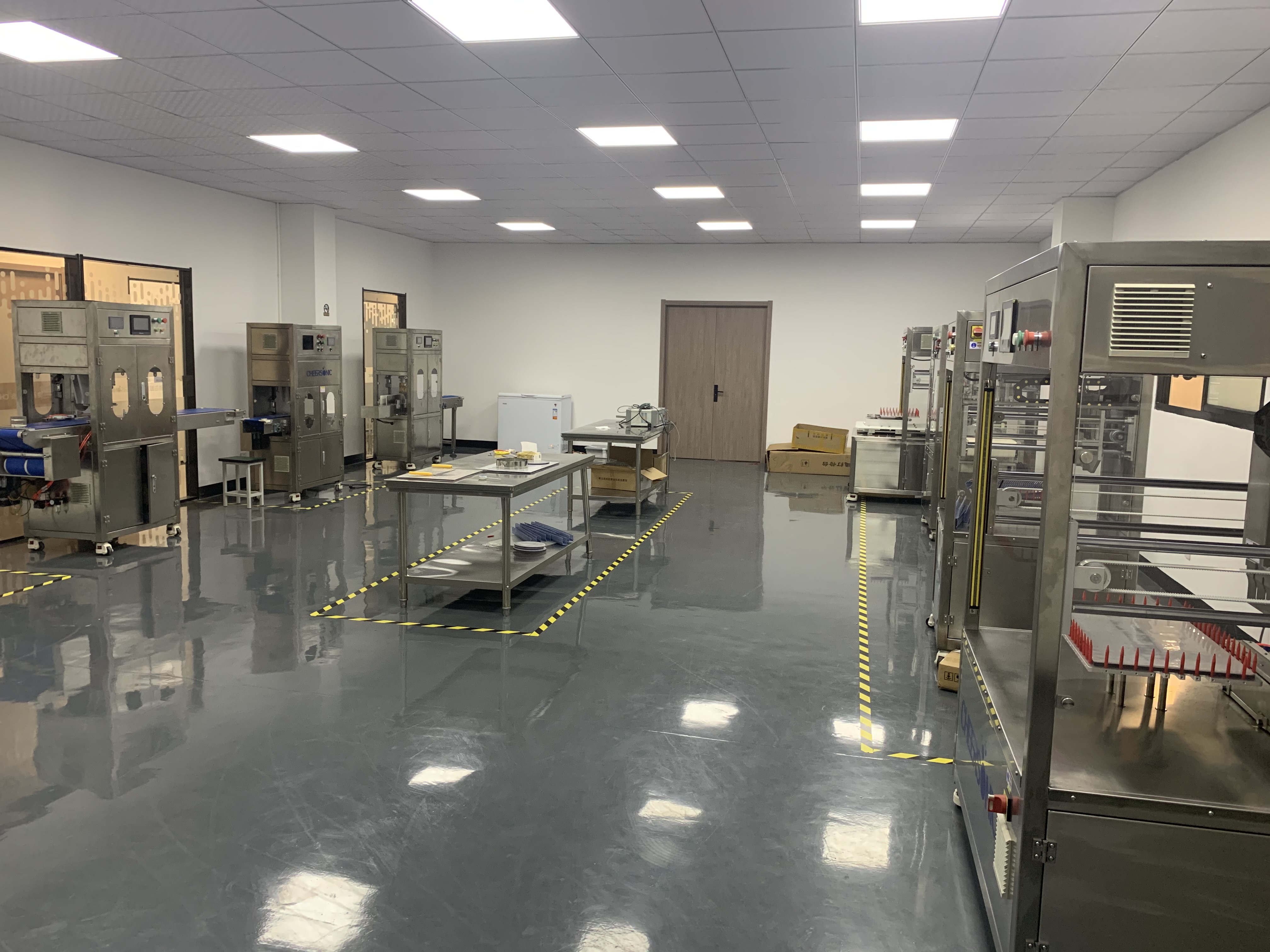
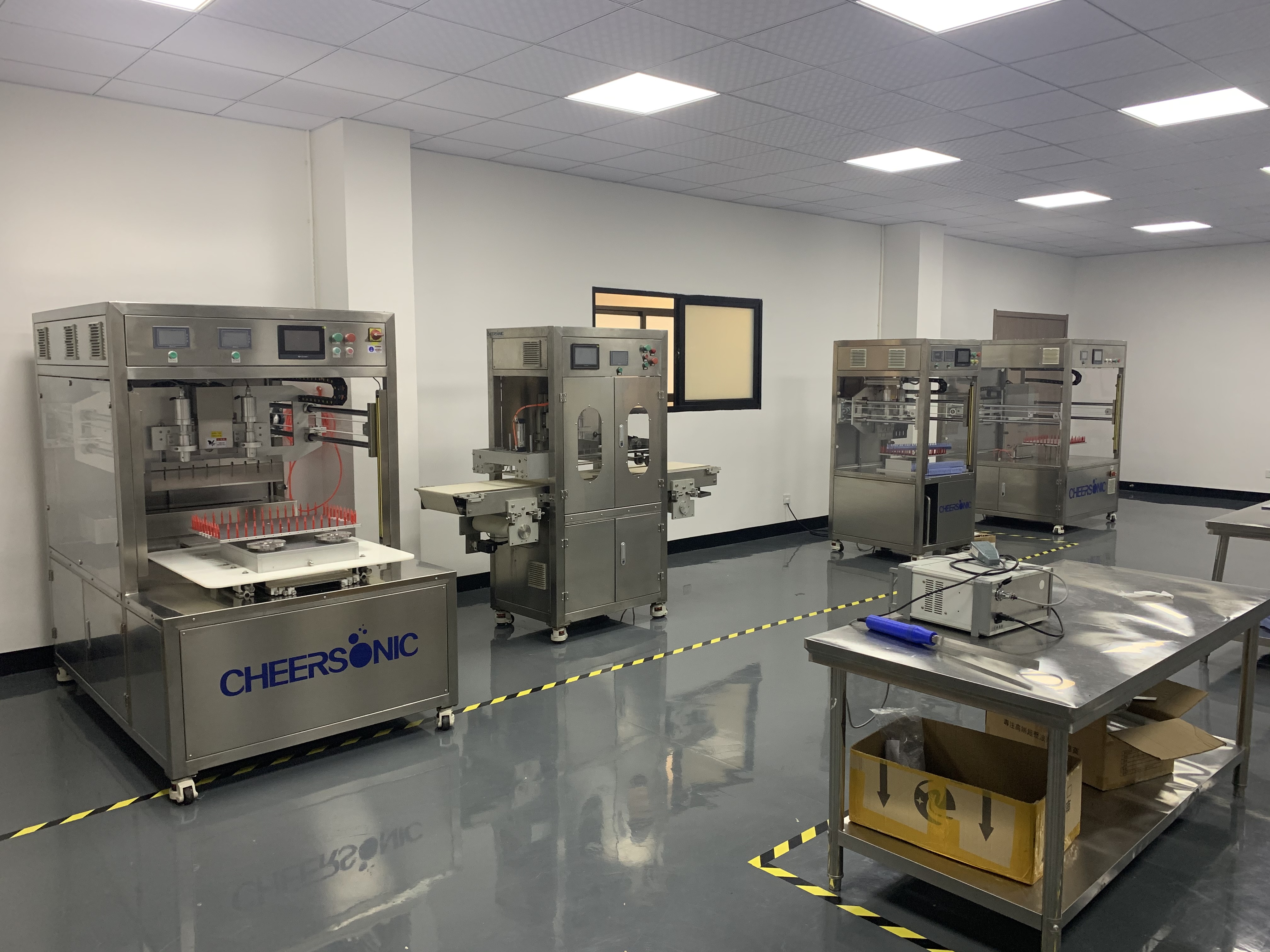
Ultrasonic machine sample workshop: application trials and parameter validation before a configuration is fixed.
Problem Definition: Why the Category Name Fails as a Specification
A request for quotation that says "we need an ultrasonic machine" describes a category, not a process. The same word covers a 20 kHz cutting blade vibrating through a frozen cheesecake at high amplitude, a 120 kHz atomizing nozzle depositing a catalyst layer a few tens of micrometres thick, and a 35 kHz welding sonotrode pressing two synthetic fabrics together at up to 600 N. These are not variations of one product. They are different parameter regimes, and a machine built for one will not perform the other.
Three failures follow from that ambiguity. First, frequency is chosen from habit rather than from the droplet size or vibration amplitude the process needs, so the tool physically cannot do the job. Second, power is chosen from price rather than from throughput, and the line runs below its rated output. Third, the liquid path is under-specified: a coating process quoted without a flow rate range cannot be planned, because frequency and flow rate together determine droplet size, film thickness and material utilisation.
Parameter mismatch is therefore a specification problem, not a quality problem. It is solved before the order with a datasheet, not after delivery with a complaint.
Industry Background: Where Ultrasonic Capacity Is Being Deployed
Adoption is broadening across both food processing and advanced manufacturing. Third-party estimates place the ultrasonic cutters market, which includes food cutting applications, at USD 2.8 billion in 2025, with a projected CAGR of 7.2% through 2033 (Dataintelo). In the liquid-delivery segment, the ultrasonic spray systems market was valued at USD 0.5 billion in 2024 and is projected to reach USD 1.2 billion by 2034 (Market Research Future). Asia Pacific accounted for roughly 25-38% of global ultrasonic technology and sensor revenue in 2025 (Fortune Business Insights). Market-size estimates vary with report scope, so treat them as directional rather than precise.
Two structural consequences follow. First, equipment is increasingly procured against a process window rather than a machine class: buyers specify droplet size, film thickness, portion accuracy or throughput, and let the supplier map those requirements to frequency and power. Second, compliance expectations have tightened. ISO 12100:2010, the general standard for machinery risk assessment and reduction, is cited as a coordinated standard in the CE attestations for ultrasonic cutting machines and ultrasonic spraying machines, alongside EN 60204-1:2018. A parameter sheet that cannot be matched to a certificate scope is a procurement risk.
Detailed Solution: Parameter Windows by Application
1. Food cutting and slicing: 20 kHz and 800-1600 W
Cutting is the most frequently specified ultrasonic application, and its window is narrow. Cheersonic ultrasonic food cutting machines operate at a vibration frequency of 20 kHz with a power range of 800-1600 W. The ultrasonic cutting machine platform specifies 800-1800 W, an input voltage of 208-240 V at 50/60 Hz (15 A), an air requirement of 6 CFM at 90 PSI, a maximum cutting width of 600 mm, a working temperature range of -14 °C to 40 °C, and IP65 washdown protection. Control is through a servo touch screen with automatic indexing.
Throughput scales with the platform. The food cutting machine produces 50-1500 pieces per hour. Ultrasonic slicing systems run up to 300 products per hour on full sheet or round products, in frozen, chilled and hard states as well as fresh, ambient and sticky states. The cutting tool range published by the same manufacturer covers up to 200-1,200 products per hour with a cutting accuracy of ±0.5-1.0 mm depending on product type, and a product height range up to approximately 100 mm.
Decision rule: specify 20 kHz ultrasonic cutting when the product is sticky, layered, cream-filled or frozen and mechanical blades cause drag, deformation, filling displacement or product build-up. Plan portioning tolerances against the ±0.5-1.0 mm accuracy band, and confirm that the required cut geometry, whether round, square, triangle, bar or a custom pattern, is covered by the tooling set.
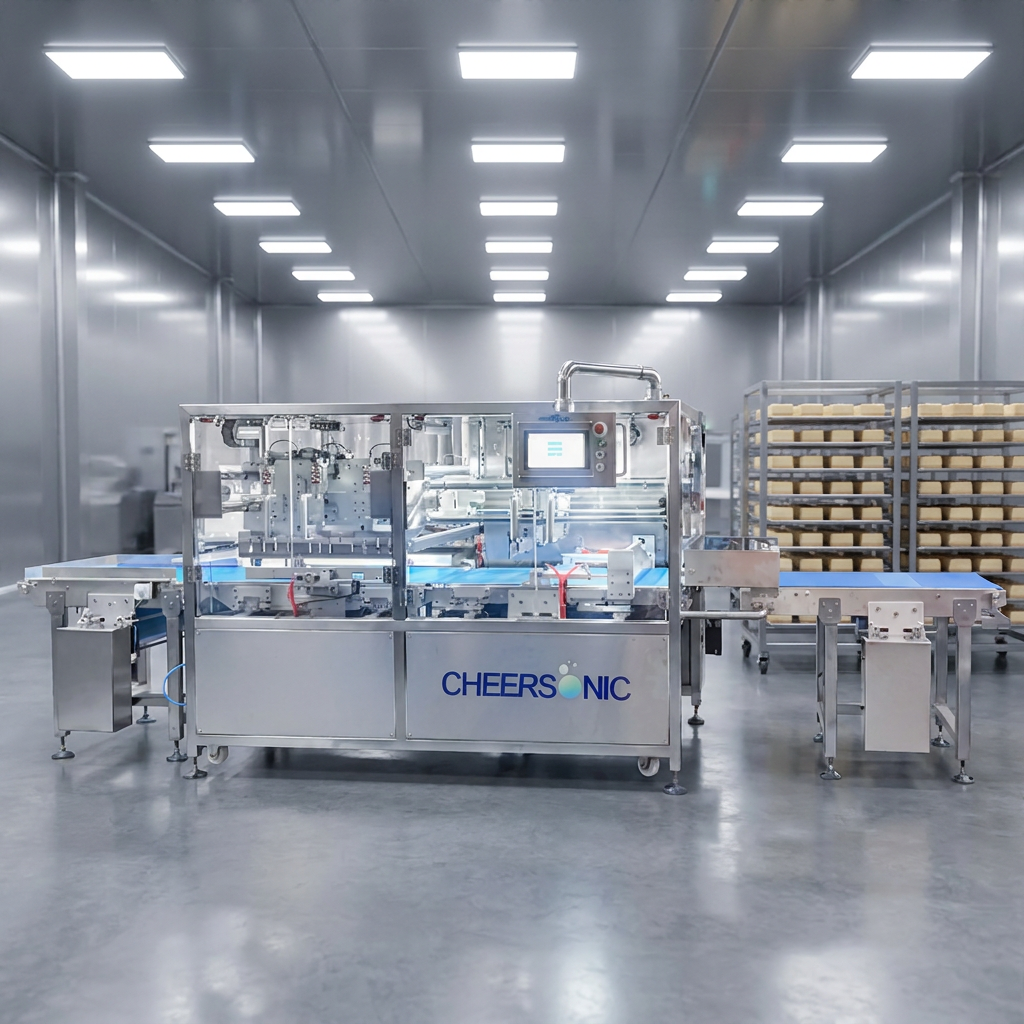
Ultrasonic cutting machine platform: 20 kHz vibration, 800-1800 W, IP65 washdown, maximum cutting width 600 mm.
2. Fluxless soldering: 20-60 kHz and 28-100 W
Soldering applies the same ultrasonic principle at a completely different scale. Cheersonic ultrasonic soldering systems operate at 20-60 kHz with an ultrasonic power of 28-100 W and a soldering temperature of 200-450 °C, using resistive heating or an integrated hot tip. Wetting is activated by ultrasonic cavitation in the molten alloy, so no chemical flux is required. The solder alloy range covers Sn-based, Zn-based and In-based alloys, and bonding strength is controlled by adjusting ultrasonic amplitude at micron-level vibration.
Because energy is coupled into a joint rather than into a blade, power stays low. That is what makes the process viable for semiconductor packaging, power electronics, glass-to-metal sealing, sensor and MEMS manufacturing, and the joining of dissimilar materials where flux residue or a pre-plated layer would be unacceptable. Process mode is manual or semi-automatic precision bonding: it is a precision joining process, not a high-throughput line operation.
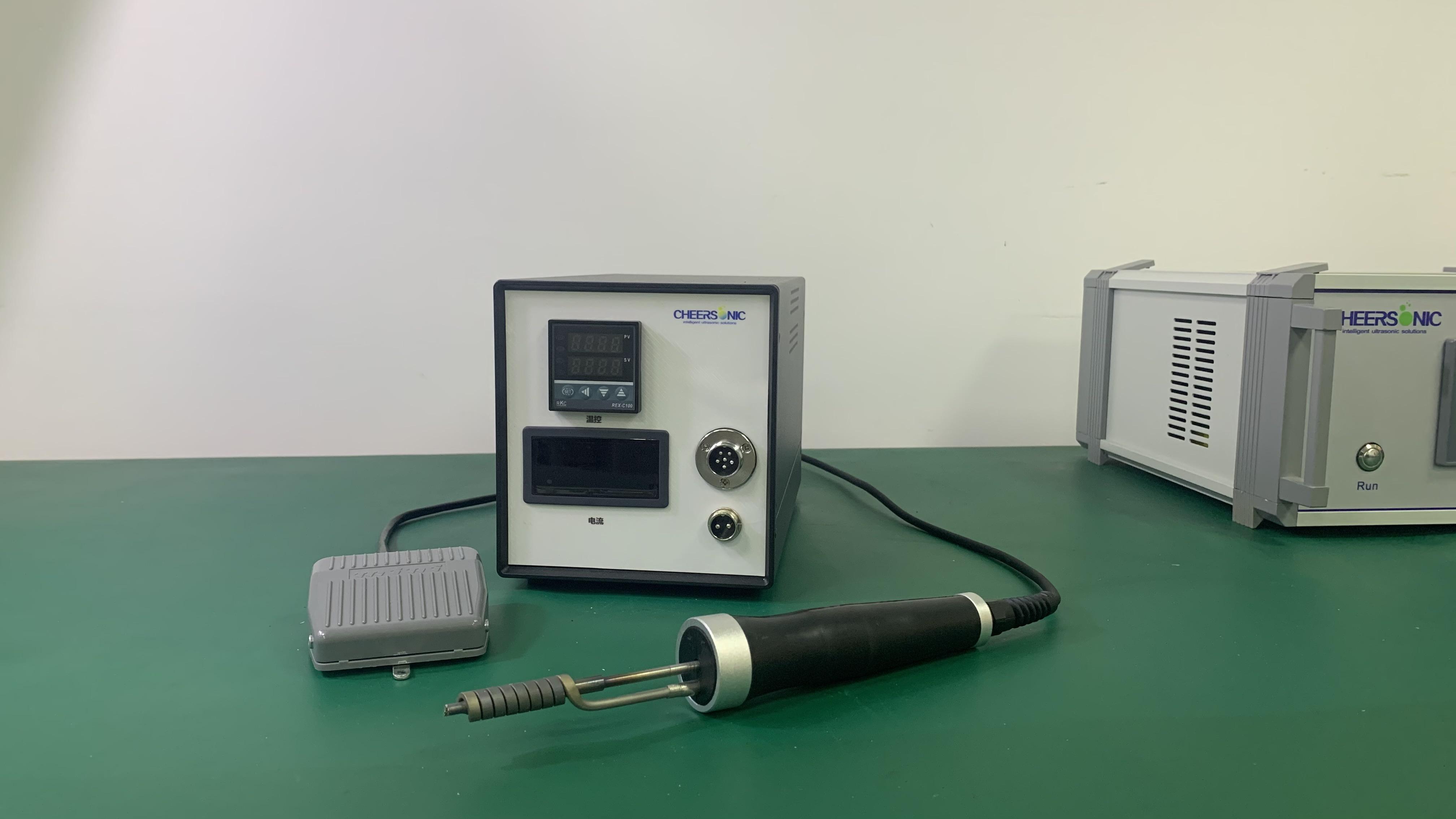
Ultrasonic fluxless soldering: 20-60 kHz, 28-100 W, soldering temperature 200-450 °C, no flux required.
3. Ultrasonic welding and sewing: 35 kHz and up to 600 N
Textile welding is a third regime. The published specification for ultrasonic bonding and sewing equipment is a 35 kHz frequency, a 220 V / 230 V / 110 V power supply, a maximum pressing force of 600 N through a digital pressure unit, and a 7-inch multi-touch control screen. The three process variables that govern weld quality are heat output, pressing force and welding time. One material constraint is stated explicitly: stable welding requires a minimum synthetic fibre content of 60% or more.
CE attestation TRCN-26118HCU01 issued by INTERTURK covers the ultrasonic sewing and cutting machine models USM350S, USM450, USM550, COS500, HC300, HGC500, HLC300, HSC500, HSW500 and KZJ under Machinery Directive 2006/42/EC and EMC Directive 2014/30/EU.
Decision rule: if the fabric blend sits below 60% synthetic content, ultrasonic welding is not the right joining process and mechanical sewing or adhesive bonding should be evaluated instead.
4. Atomisation, spray coating and spray pyrolysis: 25-180 kHz with 0.001-50 mL/min
The atomising family covers the widest frequency range. Cheersonic ultrasonic atomisers and ultrasonic spray nozzles operate at 25-180 kHz with a power consumption of 1-8 W per nozzle, a flow rate of 0.001-50 mL/min, a droplet size of approximately 18-200 μm depending on frequency, and a film thickness of 20 nm-100 μm. Atomisation is based on non-clogging ultrasonic vibration, and the liquid viscosity limit is up to 100 cP. Nozzle models in the range include UCA120, UCA50, UCW50, UCW120, UCR50, UCR40, UCR60 and UCT120.
The same platform is configured for different coating tasks. UAM4000 and UAM6000 serve ultrasonic spray coating and general ultrasonic coating. UAM4000, UAM6000 and UAM8000 serve fuel cell catalyst coating. USP6000 and USP6000WS serve ultrasonic photoresist coating. UAM2000 with UNC9000 serves ultrasonic spray pyrolysis, where the pyrolysis temperature is 400-1200 °C, particle size is 20 nm-5 μm, and the carrier gas can be air, nitrogen or oxygen.
Decision rule: droplet size is frequency dependent, so frequency is fixed first and flow rate is then tuned to hit the required film thickness. Where per-unit-area loading must be tightly controlled, as with catalyst layers, photoresist or flux, stay at the low end of the 0.001-50 mL/min range and confirm that the nozzle is compatible with the slurry viscosity.

Ultrasonic spray nozzle: 25-180 kHz, 1-8 W per nozzle, 0.001-50 mL/min, droplet size approximately 18-200 μm.
5. Dispersion: 20 kHz and 80-2000 W
Liquid preparation sits upstream of coating and is specified separately. Cheersonic ultrasonic homogenisers operate at a standard 20 kHz frequency with a power range of 80-2000 W, amplitude adjustable from 1% to 100%, processing volumes of 0.5 mL-20 L on laboratory models, programmable continuous or pulse sonication, and a programmable processing time of 1 s-99 h. Probe matching matters: a microtip is used for volumes of 50 mL or less, and a large horn for 1 L or more. Dispersion stability of up to four months has been documented for a multi-walled carbon nanotube aqueous system.
6. Blade and wetted-path material: stainless steel or titanium alloy
Material selection follows function. Parts that vibrate and contact the product are specified in titanium alloy: cheese cutting and cake cutting systems use a titanium ultrasonic blade (sonotrode), and cutting tools use interchangeable ultrasonic titanium blades. A separate FDA test report, NGBHG1805981901 issued by SGS-CSTC Standards Technical Services Co., Ltd. Ningbo Branch, covers a titanium alloy blade under FDA Compliance Policy Guides Sec.545.500 (CPG 7117.05). Stainless steel appears alongside titanium alloy as the specified material across the cutting, atomising and coating range, and food-grade stainless steel construction is specified for dairy and bakery systems. Conveyor material is covered separately: a PU (TPU) conveyor belt carries test report XMAFF170601257E-2 against FDA 21 CFR 177.2600.
Practical guidance: treat titanium alloy as the default specification for the vibrating blade or sonotrode that touches product or substrate, and stainless steel for structural, housing and non-vibrating contact parts. Confirm the exact part against the bill of materials rather than assuming the whole machine shares a single material.
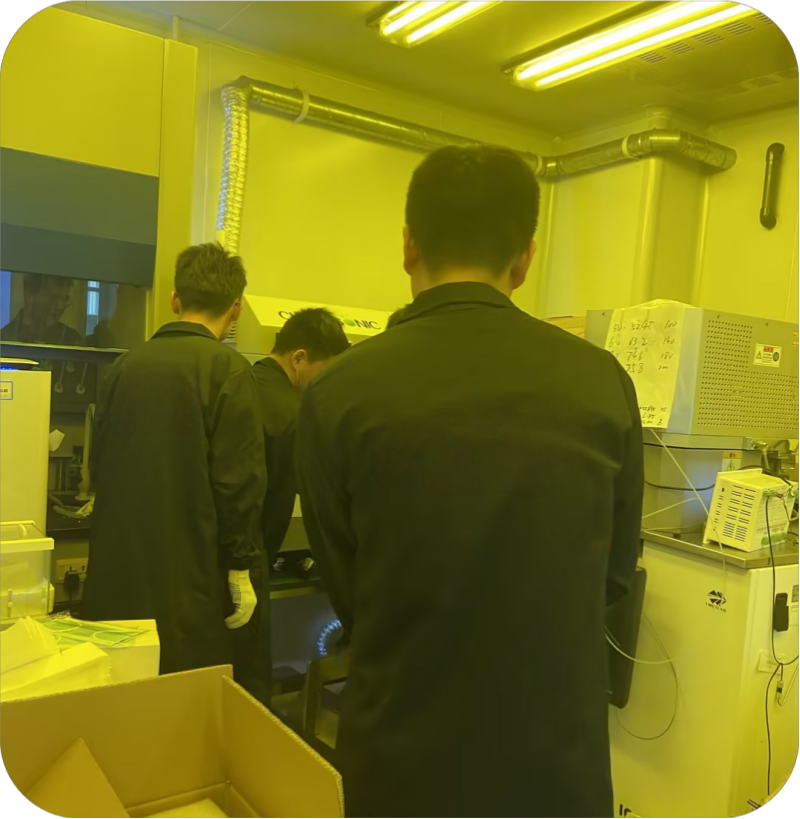
Photoresist coating system (USP6000 / USP6000WS): 25-180 kHz atomisation, 0.001-50 mL/min, film thickness 20 nm-100 μm.
Step-by-Step Breakdown: Specifying a Machine in Six Steps
- Name the process, not the product. Decide whether the task is cutting or slicing, soldering or welding, atomising or coating, or dispersing. Each family maps to a different frequency and power window, and the families do not overlap.
- Fix frequency from the contact physics. Use 20 kHz where a blade performs high-amplitude mechanical work and cuts food. Use 25-180 kHz where a liquid must be atomised and droplet size is frequency dependent. Use 20-60 kHz for fluxless soldering and 35 kHz for textile welding.
- Size power against throughput. For cutting, the food cutting machine specifies 800-1600 W and the cutting machine platform 800-1800 W, supporting 50-1500 pieces per hour; slicing systems run up to 300 products per hour; cutting tool configurations reach 200-1,200 products per hour. For atomising nozzles, consumption is only 1-8 W per nozzle, because the energy goes into droplet formation rather than into material displacement.
- Define the liquid path. Set the flow rate within 0.001-50 mL/min, confirm liquid viscosity compatibility up to 100 cP, and set the target film thickness within 20 nm-100 μm. For pyrolysis, add the process temperature (400-1200 °C), the target particle size (20 nm-5 μm) and the carrier gas.
- Confirm the operating environment. Check input voltage (208-240 V, 50/60 Hz, 15 A on cutting machines), air supply (6 CFM at 90 PSI), protection class (IP65 washdown on cutting platforms) and ambient working temperature (-14 °C to 40 °C). These determine whether the machine can be installed in a washdown food area, a clean laboratory or a semiconductor line.
- Match compliance and acceptance scope. Verify that your exact model number appears inside the CE certificate scope, that ISO 9001:2015 certification is current, and that the supplier runs a pre-shipment full performance test with video and test reports.
A parameter that is missing from the datasheet is a parameter you cannot plan around. If a quotation does not state frequency, power, flow rate and protection class, request them in writing before the order, not after installation.
Comparison Table: Parameter-to-Application Map
| Application | Operating frequency | Ultrasonic power | Flow rate / secondary parameter | Published platform |
|---|---|---|---|---|
| Food cutting (cake, cheese, confectionery, ready-to-eat) | 20 kHz | 800-1600 W (food cutting machine); 800-1800 W (cutting machine) | Max cutting width 600 mm; 50-1500 pcs/h; IP65 washdown; 208-240 V, 50/60 Hz, 15 A | UFM / HFM cutting series |
| Ultrasonic slicing (frozen, chilled, fresh, sticky) | Approximately 20 kHz (ultrasonic blades) | Not stated separately | Up to 300 products per hour; full sheet or round products | HFM2300, HFM3100, UFM series |
| Cutting tools inside automated lines | Approximately 20 kHz | Not stated separately | 200-1,200 products/h; accuracy ±0.5-1.0 mm; product height up to approximately 100 mm | Interchangeable titanium blade platforms |
| Fluxless soldering | 20-60 kHz | 28-100 W | Soldering temperature 200-450 °C; flux-free cavitation activation | USE-60P / USE-60E, USE-40P / USE-40E, USE-28P / USE-28E |
| Ultrasonic welding and sewing | 35 kHz | Pressing force up to 600 N | Minimum 60% synthetic fibre content for stable welding; 220/230/110 V supply | USM350S, USM450, USM550, COS800, HGC500 |
| Spray coating and atomisation | 25-180 kHz | 1-8 W per nozzle | 0.001-50 mL/min; droplets approximately 18-200 μm; film 20 nm-100 μm; viscosity up to 100 cP | UAM4000, UAM6000; nozzles UCA / UCW / UCR / UCT |
| Fuel cell catalyst coating | 25-180 kHz | Not stated separately | 0.001-50 mL/min; high-uniformity catalyst coating | UAM4000 / UAM6000 / UAM8000 |
| Photoresist coating | 25-180 kHz | Not stated separately | 0.001-50 mL/min; edge-to-edge coating uniformity | USP6000, USP6000WS |
| Spray pyrolysis | 25-180 kHz | Not stated separately | 0.001-50 mL/min; 400-1200 °C; particle size 20 nm-5 μm; carrier gas air, nitrogen or oxygen | UAM2000, UNC9000 |
| Dispersion (upstream liquid preparation) | 20 kHz | 80-2000 W | Amplitude 1-100%; volume 0.5 mL-20 L; continuous or pulse mode | LUIP500, IUIP1000-IUIP5000 |
| Selection point | Titanium alloy | Stainless steel |
|---|---|---|
| Where it is specified | Blade / sonotrode: titanium ultrasonic blade in cheese and cake cutting systems; interchangeable ultrasonic titanium blades in cutting tools | Listed together with titanium alloy as the specified material across cutting, atomising and coating products; food-grade stainless steel construction for dairy and bakery systems |
| Published compliance evidence | FDA test report for titanium alloy blade, NGBHG1805981901 (SGS-CSTC Ningbo), FDA Compliance Policy Guides Sec.545.500 (CPG 7117.05) | Food-grade hygienic and washdown design specified for the food cutting platforms |
| Typical engineering role | The vibrating part that contacts product or substrate | Structural, housing and non-vibrating contact parts, confirmed part by part |
| What to confirm at quotation | Part-level material specification, not machine-level | Part-level material specification, not machine-level |
Use Cases: How the Window Plays Out in Production
Dairy: portioning wheel cheese
A dairy manufacturing enterprise in Ireland (4 units, five years in service) uses an integrated unit combining automatic weighing, intelligent material calculation and ultrasonic cold cutting for wheel cheese. Reported outcomes include an equipment footprint reduced by more than 70%, reduced cheese edge and corner loss through dynamic optimisation of the cutting plan, changeover time reduced by 70% with one operator per machine, and automatic archiving of production data for cost control and quality documentation. The parameter reason the system works is ultrasonic cold cutting: no mechanical extrusion and no frictional heat, so the cut surface is neither deformed nor smeared.
Bakery: dessert cutting with paper insertion
A boutique baking production enterprise in the United Kingdom deployed an ultra-compact integrated desktop cake cutting machine that performs ultrasonic cold cutting and paper insertion in a single pass. Reported outcomes include removal of one dedicated paper-insertion operator per machine, 60% space saving, a 45% increase in hourly processing efficiency and a 99% finished product qualification rate. A separate large baking installation (1 unit, five years) reported 99% product qualification, a 32% reduction in raw material loss and a 2.4 times increase in shift cutting capacity after ultrasonic cutting was integrated into an existing automated line.
Energy: fuel cell catalyst coating
A national fuel cell and clean energy research institute in Canada (1 unit, six years) coats PEM catalyst layers, gas diffusion layer microporous layers and MEA samples using 120 kHz high-frequency soft atomisation with XYZ three-axis programmable spraying and a built-in vacuum adsorption heating platform. Reported outcomes include catalyst slurry utilisation above 95%, reduction of platinum-carbon slurry loss by nearly 80%, MEA peak power density batch deviation reduced from 12% to 3% or less, proton membrane scrap reduced from 28% to below 2%, and single-batch sample preparation time shortened by 40%. Coating thickness is controllable from 20 nm to 100 μm with a uniformity figure of CV 3% or better. This is what the 25-180 kHz / low-flow window buys: thin, repeatable layers on a fragile substrate.
Semiconductor: fluxless heterogeneous joining
A semiconductor equipment manufacturer in the United States (2 sets, four years) uses active soldering to join aluminium, copper, silicon, ceramics and hard alloys without flux, for sputtering target backplate bonding, optical mirror encapsulation and gas flow controller sealing. Reported outcomes include extremely low interface porosity, no residual flux contamination in the plasma chamber, weld shear strength above 5000 psi, resistance to high and low temperature cycling, and reworkability of the joint. The 20-60 kHz / 28-100 W window is what makes this possible without a chemical flux step.
Medical devices: stent and balloon catheter coating
Drug coating for drug-eluting stents and balloon catheters runs on the same 25-180 kHz atomising platform, with a rotating fixture for full coverage and a sealed negative-pressure cavity with solvent recovery. The decisive parameter is the absence of high-pressure airflow: low-kinetic-energy ultrasonic atomisation deposits the coating without the mechanical stress that pressure spraying places on thin polymer substrates.
Frequently Asked Questions
Which certificates should I verify before an ultrasonic cutting or coating machine ships to the EU?
Three certificate families matter, and each has a scope that must be matched to your exact model. For ultrasonic food cutting machines, CE attestation TTC-22-2802/10/02 issued by INTEGRA96 covers models HFM3000, UFM4000, UFM5000L, UFM6000, UFM6000L, UFM1000P, UFM700P, UFM3500 and UFM8000 against Machinery Directive 2006/42/EC and Low Voltage Directive 2014/35/EU, with coordinated standards EN ISO 12100:2010 and EN 60204-1:2018, valid from 28 February 2022 to 27 February 2027. For ultrasonic spraying machines, CE attestation TRCN-26118HCU02 issued by INTERTURK covers UAM1000, UAM2000, UMC3000, UAM4000, UAM6000, UMC7100, UAM8000, UAM9000, UAC50 and UAC120 under 2006/42/EC, 2014/35/EU and 2014/30/EU, valid to 27 April 2031. For ultrasonic sewing and cutting machines, TRCN-26118HCU01 covers USM350S, USM450, USM550, COS500, HC300, HGC500, HLC300, HSC500, HSW500 and KZJ. At company level, ISO 9001:2015 certification (certificate 17325Q21416R2S, GB/T 19001-2016 / ISO 9001:2015, valid to 25 December 2028) covers production of ultrasonic cutting, spraying and liquid handling equipment as well as research and production of ultrasonic piezoelectric transducers. Blade material is covered separately by FDA test report NGBHG1805981901 for a titanium alloy blade. Always confirm that your model number appears inside the certificate scope.
Can an OEM ultrasonic machine manufacturer adapt frequency, power and flow rate to my application?
Yes, and that adaptation is what separates an OEM or ODM engagement from a catalogue purchase. Cheersonic provides both OEM and ODM production services, with a customisation scope that includes equipment size, cutting specification, operating voltage, control program, machine appearance, brand logo, functional module and production line docking structure. The R&D base behind that scope includes a 20-engineer team, 31 patents and 3 software copyrights, with manufacturing based in Fuyang District, Hangzhou. Frequency, power and tooling are therefore derived from the application window, such as 20 kHz at 800-1600 W for food cutting or 25-180 kHz with 0.001-50 mL/min for coating, rather than selected from a fixed list.
What is the minimum order quantity, and what commercial terms apply?
The minimum order quantity is 1 unit, which allows a pilot machine to be validated before any line-scale commitment. Delivery is arranged on FOB, CIF or DDP terms. Payment terms are 30% T/T advance deposit on order confirmation and 70% balance T/T against a copy of the bill of lading. Because MOQ is 1 unit, the configuration variables that drive a quotation are the same variables that drive process fit: equipment size, cutting specification, operating voltage, control program, functional modules and production line docking structure.
How is an ultrasonic machine validated before shipment?
Acceptance inspection includes a pre-shipment full performance test at the manufacturer's factory. Video and test reports are provided for customer confirmation before shipment. Quality control across production covers raw material incoming inspection, semi-finished product spot check, finished product ageing test and a 100% full machine running test before delivery.
What are the lead times for standard and customised ultrasonic machines?
Standard models ship in 7-15 days; customised models require 30-45 days. Monthly capacity for ultrasonic cutting equipment is 30 sets, and export markets served include the EU, Southeast Asia, the Middle East, North America and Australia. After-sales support covers remote online technical support, overseas engineer on-site service, spare parts supply, regular operation guidance and lifetime maintenance consultation. To move from parameters to a quotation, send the intended process (cutting, soldering, coating or dispersion), the required frequency window and the target throughput to market2@cheersonic.com or call +86 133-7254-0303, and review the full catalogue in the Cheersonic brochure before the technical review call.
Conclusion: Frequency First, Then Power, Then Flow Rate
Selection becomes straightforward once the sequence is fixed. Identify the task family, then set frequency from the contact physics: 20 kHz for cutting and slicing, 20-60 kHz for fluxless soldering, 35 kHz for textile welding, 25-180 kHz for atomisation, coating and pyrolysis, and 20 kHz for dispersion. Size power against throughput within the published ranges, from 1-8 W per atomising nozzle up to 800-1800 W on cutting platforms. Define the liquid path within 0.001-50 mL/min and a film thickness of 20 nm-100 μm where coating applies. Then verify the environment, the blade or sonotrode material, and the certificate scope that covers your model number.
A machine that matches its window does not need to be defended by adjectives. It cuts 300 products per hour cleanly, holds coating uniformity at CV 3% or better, or activates a flux-free solder joint above 5000 psi, and the datasheet shows why.
Next Step
Send your process window (task, frequency, power, flow rate and target throughput) and Cheersonic will confirm the matching configuration, blade or nozzle material, and certificate scope for your market. Sample validation, performance test reports and DDP delivery options are available from MOQ 1 unit.
Email: market2@cheersonic.com | Tel: +86 133-7254-0303 | WhatsApp: +86 158-6904-9660 | Website: www.cheersonic.com
Download the full product catalogue: Cheersonic brochure (PDF)
Have Questions or Need More Details?
Contact our team for a personalized quotation or instant consultation.
Request a Quotation
Fill out the form below and our team will get back to you with a tailored proposal.
WhatsApp Direct Chat
Prefer to chat in real-time? Message us on WhatsApp for instant assistance & quick answers.
- Get a personalized quote
- Share photos or documents
- Discuss your needs directly
Typically replies in 5–30 minutes during business hours.