
Solving the Clean-Cut Challenge: How Ultrasonic Slicing Prevents Crumbs and Cracks
Crumbs and cracks are not cosmetic defects. In industrial food cutting, they signal lost yield, rejected batches, and unstable production. Ultrasonic slicing addresses the root cause by replacing mechanical pressure with high-frequency blade vibration. This article explains the mechanism, the configuration choices, and the verified performance data that food processors need when evaluating ultrasonic cutting equipment.
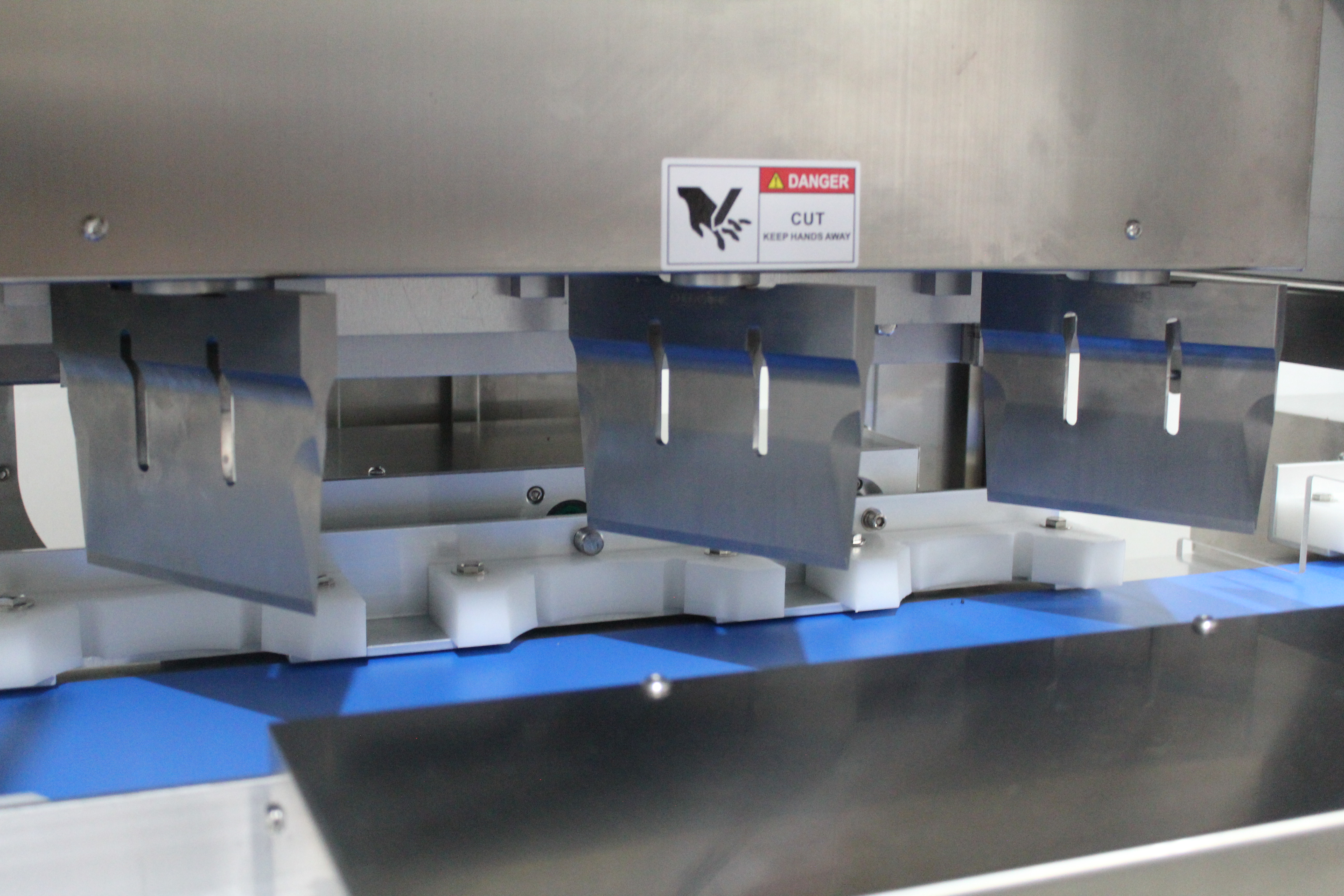
Cheersonic ultrasonic food cutting system configured for multi-station synchronous cutting.
Why Conventional Cutting Produces Crumbs and Cracks
Traditional food cutting relies on a blade pressing through a product. For firm, homogeneous materials, that mechanical action is adequate. For fragile, layered, sticky, or temperature-sensitive products, the same action creates three predictable failure modes:
- Compression deformation. Soft cakes, cream-filled layers, and cheese deform under blade pressure before the blade edge separates the material.
- Sticking and tearing. Sticky products adhere to the blade surface, pulling structure apart as the blade withdraws.
- Fracture and cracking. Frozen or brittle products, including chocolate and chilled cheese, crack when the blade displaces rather than slices.
These failure modes produce crumbs, cracks, and delamination. The result is measurable: rejected units, downgraded product, additional cleaning downtime, and reduced line throughput.
How Ultrasonic Slicing Changes the Cutting Mechanism
Ultrasonic slicing replaces continuous blade pressure with high-frequency vibration. Cheersonic ultrasonic cutting systems operate at approximately 20 kHz, using interchangeable titanium alloy blades. The vibration reduces friction between blade and product, allowing the blade to separate material with minimal downward force.
Key mechanism: At 20 kHz, the blade oscillates rapidly enough that cutting becomes a low-friction separation process rather than a compression process. Cheersonic product data describes this as non-stick, low-friction slicing for soft, sticky, layered, and cream-filled products.
Three consequences follow for fragile products:
- Less compression. Soft layers retain their height and shape.
- Less sticking. Sticky surfaces release from the vibrating blade.
- Less fracture. Frozen and brittle products separate cleanly without impact cracking.
The mechanical result is a clean cut with reduced crumbs and fewer cracks. Cheersonic reports cutting accuracy of ±0.5–1.0 mm depending on product type, using interchangeable ultrasonic titanium blades.
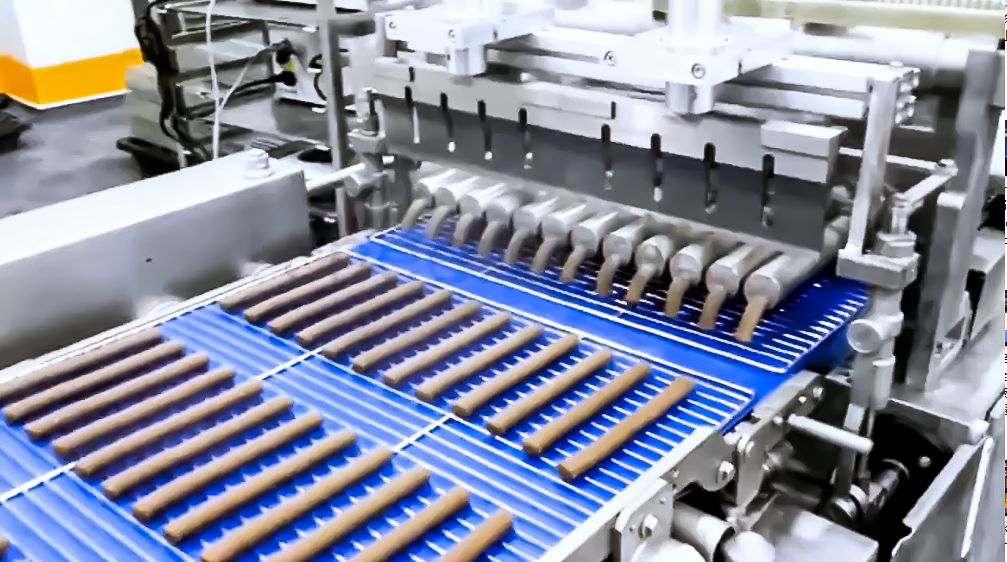
Ultrasonic slicing machine configured for fresh, ambient, and sticky products.
Industry Background: Why Clean Cutting Matters More Than Ever
Food processors face increasing pressure on three fronts: product presentation, yield control, and production flexibility. A single cutting defect can affect all three.
Presentation. Layered cakes, cream-filled desserts, cheese slices, and composite snack bars are judged by edge quality. Crumbs and cracks are visible defects that reduce retail value.
Yield. Crumbs represent lost product. Cracks in cheese or chocolate represent rejected units. Both increase raw-material consumption per finished unit.
Flexibility. Production lines increasingly run multiple products on the same equipment. A cutting method that works only for one texture constrains changeover and scheduling.
Ultrasonic cutting addresses these pressures because the same vibration principle applies across fresh, ambient, sticky, frozen, chilled, and hard products, with the appropriate blade and configuration.
The Cheersonic Ultrasonic Slicing Solution
Cheersonic (Hangzhou Cheersonic Ultrasonics Equipments Co., Ltd.) is a manufacturer of ultrasonic cutting and ultrasonic spraying equipment, founded in 2014 and based in Fuyang District, Hangzhou, China. The company operates a 7,150 m² factory with 20 R&D engineers and annual production of 1,200 units. It holds 31 patents and 3 software copyrights, and maintains ISO9001, EU CE, and US FDA-related compliance documentation.
For food cutting, Cheersonic offers ultrasonic slicing machines, ultrasonic cutting machines, ultrasonic food cutting machines, ultrasonic cake cutting machines, and ultrasonic cheese cutting machines. Relevant performance facts from the product data include:
- Ultrasonic slicing (fresh, ambient, sticky products): up to 300 products per hour; full sheet or round product types; ultrasonic blade portioning.
- Ultrasonic slicing (frozen, chilled, hard products): up to 300 products per hour; full sheet or round product types; ultrasonic blade portioning.
- Ultrasonic cutting tools: cutting speed up to 200–1,200 products per hour; blade vibration frequency approximately 20 kHz; cutting accuracy ±0.5–1.0 mm depending on product type.
- Ultrasonic cutting machine: working frequency 20 kHz; power range 800–1,800 W; output capacity 50–1,500 pieces per hour; working temperature -14°C to 40°C; IP65 washdown grade.
- Ultrasonic food cutting machine: vibration frequency 20 kHz; power range 800–1,600 W; production capacity 50–1,500 pcs/h; processing temperature -14°C to 40°C; max cutting width 600 mm.
These figures show the balance between speed and quality: the ultrasonic slicing configuration reaches up to 300 products per hour while maintaining clean, non-stick cutting behavior on fragile products.
Step-by-Step Breakdown: Configuring Ultrasonic Slicing for Clean Cuts
Step 1 — Define the Product and Its Failure Mode
Start with the product condition: fresh, ambient, sticky, frozen, chilled, or hard. This determines whether the fresh/ambient/sticky slicing configuration or the frozen/chilled/hard configuration is appropriate. It also determines blade selection and temperature handling.
Step 2 — Match Throughput to Line Capacity
Ultrasonic slicing configurations are rated up to 300 products per hour, while broader ultrasonic cutting machine configurations are rated from 50 to 1,500 pieces per hour. Select the configuration that matches the required line output rather than the maximum catalogue figure.
Step 3 — Select Blade and Tooling
Cheersonic uses interchangeable ultrasonic titanium blades. Titanium alloy construction supports food-contact use, and the company holds an FDA test report for the titanium alloy blade (NGBHG1805981901, SGS-CSTC, under FDA Compliance Policy Guides Sec.545.500). Quick-release sanitary blade design supports cleaning and changeover.
Step 4 — Choose Inline or Offline Integration
Cheersonic offers both standalone machines for manual baking facilities and large inline robotic solutions for high-speed production. Inline configurations integrate with conveyor systems, indexing systems, and packaging lines; offline configurations support batch or lower-volume production.
Step 5 — Validate with a Sample Test
Before shipment, acceptance inspection includes a pre-shipment full performance test at the factory. Video and test reports are provided for customer confirmation. This validation step is particularly important for new products or unusual textures.
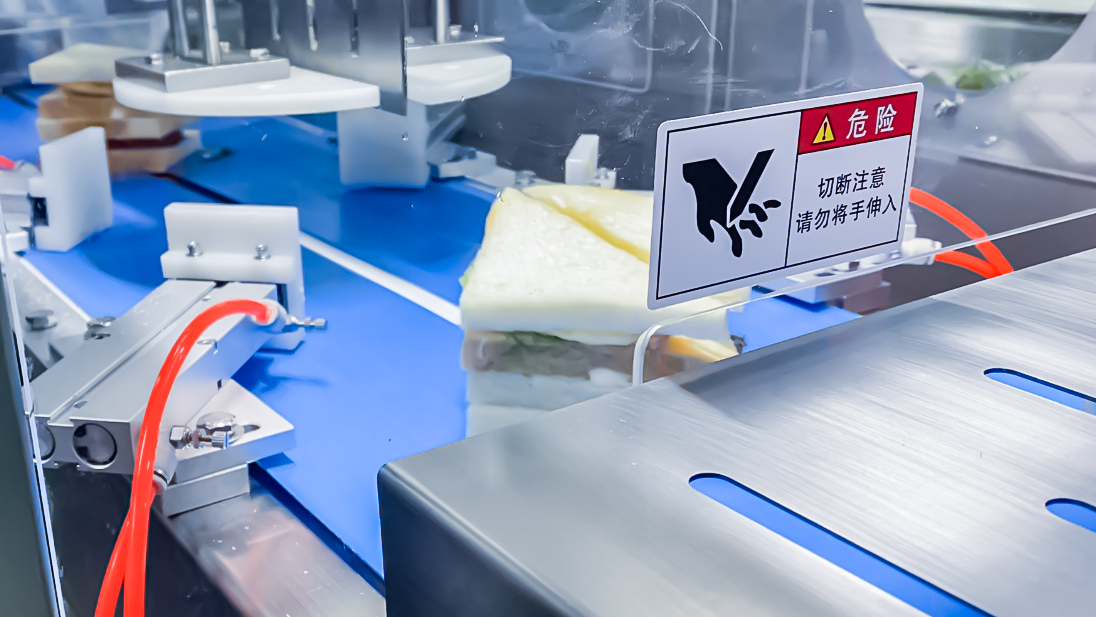
Ultrasonic cold cutting applied to layered sandwiches, avoiding overflow and falling debris.
Use Cases: Where Ultrasonic Slicing Eliminates Crumbs and Cracks
Ready-to-Eat Sandwiches (France)
A ready-to-eat food manufacturer in France uses six Cheersonic units for fully automatic assembly-line cutting of sandwiches containing meat, vegetables, and sauces. Reported results after five years include doubling of production capacity, a 99% product qualification rate, a 36% reduction in raw material loss, and elimination of overflowing or falling debris through ultrasonic non-extrusion cold cutting.
Composite Snack Bars (United States)
A high-end leisure snack manufacturer in the United States uses one unit for automated assembly-line slicing of double-layer composite snack sticks. The reported outcome is higher productivity, lower defect rate, and lower labor cost, supported by an assembly-line integrated design that is anti-sticking, prevents delamination, and is FDA compliant.
Filled Pies (Russia)
A baking and pre-made food processing enterprise in Russia uses three units for automated equal cutting of fruit, meat, and cream pies. Reported results after seven years include a 200% increase in production capacity, a 98% product qualification rate, a 35% reduction in raw material loss, and a 60% reduction in production change time. The three-station synchronous cutting design uses ultrasonic cold cutting without filling overflow or knife sticking.
Chocolate and Composite Confectionery (United States)
A confectionery manufacturer in the United States uses one unit for automated inline cutting of pure chocolate bars and rocky road composite chocolate products. Reported results after two years include a 40% reduction in labor costs, a 65% increase in hourly production capacity, and elimination of particle shedding, sectional cracking, and chocolate melting through high-frequency ultrasonic non-stick cutting.
Frozen Seafood (Poland)
A seafood deep-processing enterprise in Poland uses five units for automated high-speed cutting of frozen and semi-frozen mackerel and herring. Reported results after three years include a 160% increase in production capacity and a 40% reduction in aquatic raw material loss, supported by non-destructive ultrasonic cutting and vibration self-cleaning anti-sticking behavior.
Boutique Bakery Production (United Kingdom)
A boutique baking production enterprise in the United Kingdom deployed an ultra-compact integrated desktop cake cutting machine with synchronous cutting and automatic paper insertion using ultrasonic cold cutting. Reported results include removal of one dedicated paper insertion operator per machine, 60% space saving, 45% increase in hourly processing efficiency, and a 99% finished product qualification rate.
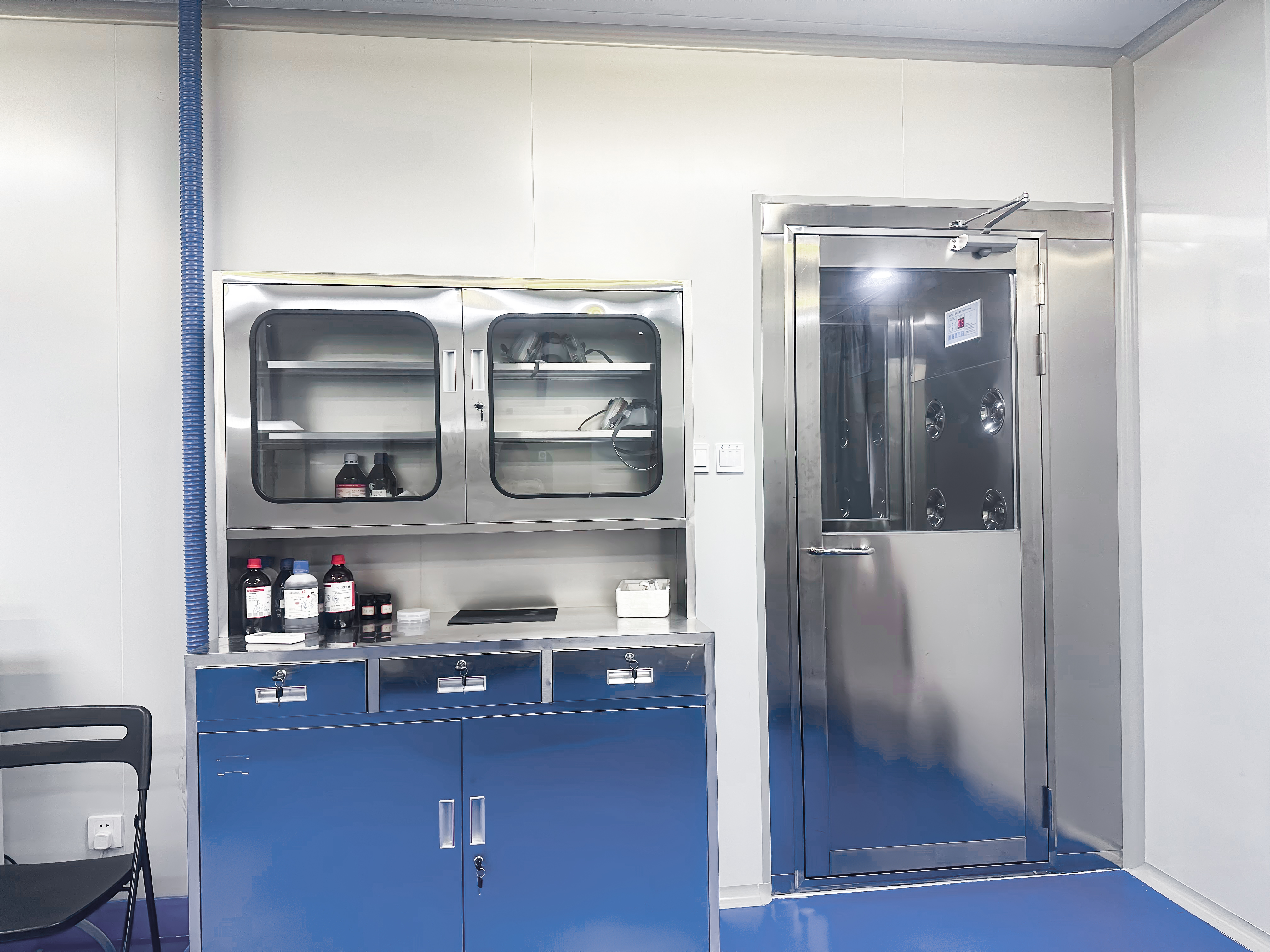
Clean laboratory environment used for ultrasonic equipment testing and process validation.
Comparison Table: Ultrasonic Slicing Configurations
The following table compares the two primary ultrasonic slicing configurations using verified product data. Both configurations use ultrasonic blade portioning and are rated up to 300 products per hour; the difference is the product temperature range they are designed to handle.
| Parameter | Ultrasonic Slicing — Fresh / Ambient / Sticky | Ultrasonic Slicing — Frozen / Chilled / Hard |
|---|---|---|
| Product Temperature | Fresh, ambient, sticky | Frozen, chilled, hard |
| Product Type | Full sheet or round | Full sheet or round |
| Speed | Up to 300 products per hour | Up to 300 products per hour |
| Portioning Technology | Ultrasonic blades | Ultrasonic blades |
| Material | Stainless steel / titanium alloy | Stainless steel / titanium alloy |
| Application Compatibility | Soft, sticky, layered, cream-filled products | Frozen, chilled, hard products |
Source: Cheersonic product data for ultrasonic slicing machine and ultrasonic slicing configurations.
FAQ
What should buyers evaluate in an OEM ultrasonic machine manufacturer?
Cheersonic provides both OEM and ODM production services, with customization covering equipment size, cutting specification, operating voltage, control program, machine appearance, brand logo, functional module, and production line docking structure. The minimum order quantity is 1 unit, monthly capacity is 30 sets of ultrasonic cutting equipment, and customized models have a lead time of 30–45 days. Buyers should confirm the customization scope, the acceptance test procedure, and the spare-parts support arrangement before placing an order.
What certifications and compliance documents are available?
The ultrasonic food cutting machine holds a CE Attestation of Compliance (certificate TTC-22-2802/10/02, issued by INTEGRA96, valid until 2027-02-27), covering models HFM3000, UFM4000, UFM5000L, UFM6000, UFM6000L, UFM1000P, UFM700P, UFM3500, and UFM8000. The company holds ISO9001 certification (certificate 17325Q21416R2S, valid until 2028-12-25). The titanium alloy blade has an FDA test report (NGBHG1805981901) issued by SGS-CSTC under FDA Compliance Policy Guides Sec.545.500.
How is the machine tested before shipment?
Acceptance inspection includes a pre-shipment full performance test at the factory. Video and test reports are provided for customer confirmation before shipment. The quality-control process also includes raw material incoming inspection, semi-finished product spot check, finished product aging test, and 100% full machine running test before delivery.
What are the minimum order quantity and payment terms?
The minimum order quantity is 1 unit. Payment terms are 30% T/T advance deposit upon order confirmation and 70% balance T/T against copy of Bill of Lading. Delivery terms include FOB, CIF, and DDP.
What is the lead time for standard and customized ultrasonic slicing machines?
Standard models have a lead time of 7–15 days. Customized models have a lead time of 30–45 days. Because ultrasonic slicing performance depends on product texture, temperature, and cut pattern, buyers can request a sample test before finalizing the configuration. Cheersonic provides remote online technical support, overseas engineer on-site service, spare parts supply, and lifetime maintenance consultation after delivery.
Conclusion
Crumbs and cracks are the visible result of a cutting mechanism that compresses rather than separates. Ultrasonic slicing changes that mechanism at the source: a titanium blade vibrating at approximately 20 kHz reduces friction and cutting force, allowing fragile products to separate cleanly instead of deforming, sticking, or fracturing.
The verified configuration data supports the practical case. Ultrasonic slicing configurations are rated up to 300 products per hour for both fresh/ambient/sticky and frozen/chilled/hard product ranges. Broader ultrasonic cutting configurations reach 50–1,500 pieces per hour with ±0.5–1.0 mm cutting accuracy depending on product type. Reported customer outcomes include 98–99% product qualification rates, reduced raw-material loss, and elimination of visible crumbs, overflow, or chocolate cracking in specific production settings.
For processors dealing with layered cakes, cream-filled desserts, cheese, chocolate, sandwiches, pies, or frozen products, the decision is not whether ultrasonic cutting is faster than mechanical cutting in every case. The decision is whether the product can tolerate the crumbs and cracks that mechanical pressure creates. When it cannot, ultrasonic slicing is the relevant engineering answer.
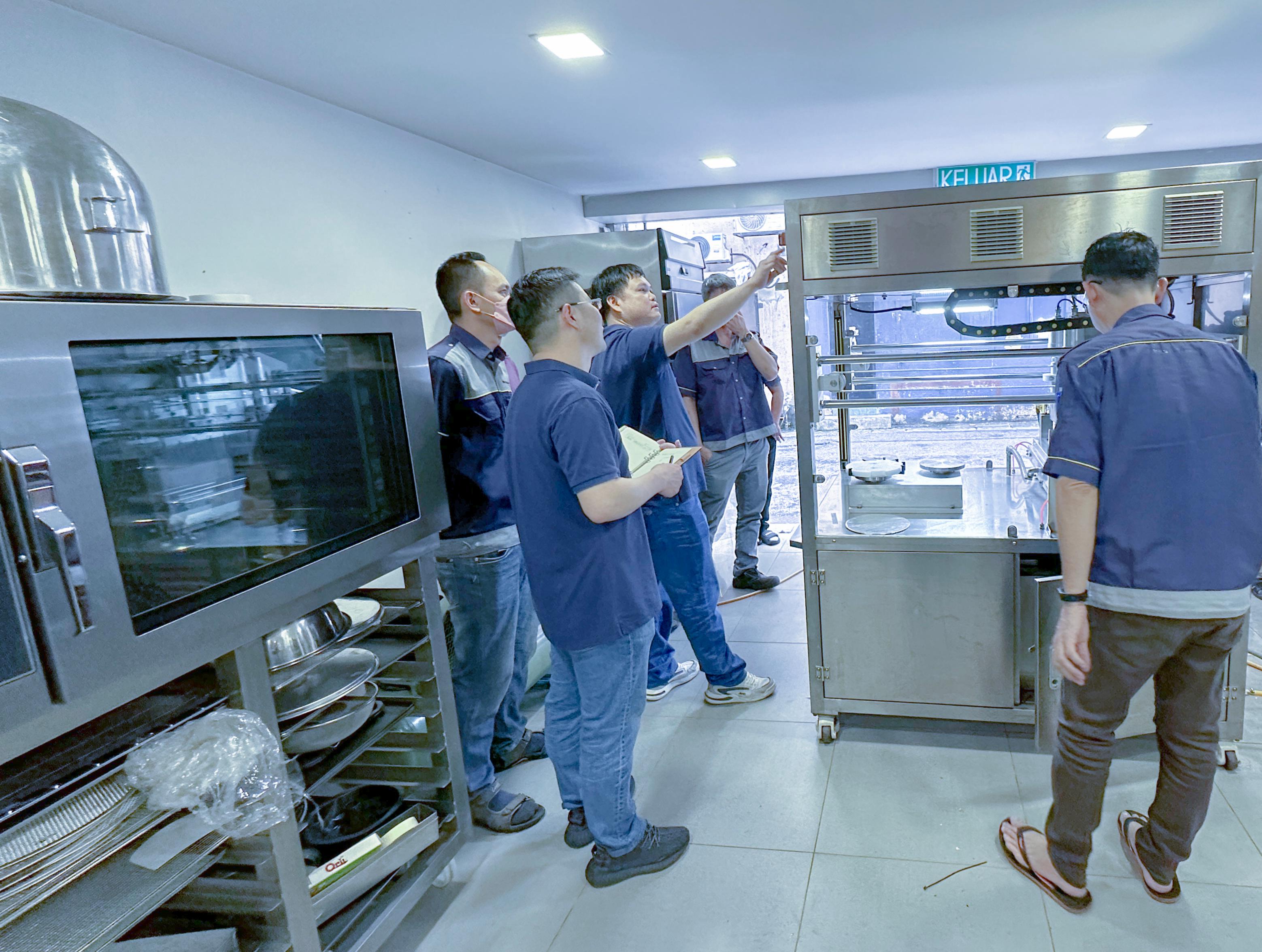
Pre-shipment full performance testing is part of the acceptance procedure.
Request a Sample Test or Quotation
Share your product type, temperature, target throughput, and cut pattern. Cheersonic will confirm the appropriate ultrasonic slicing configuration, blade selection, and integration option.
Email: market2@cheersonic.com | Tel: +86 133-7254-0303 | WhatsApp: +86 158-6904-9660
Website:www.cheersonic.com
Have Questions or Need More Details?
Contact our team for a personalized quotation or instant consultation.
Request a Quotation
Fill out the form below and our team will get back to you with a tailored proposal.
WhatsApp Direct Chat
Prefer to chat in real-time? Message us on WhatsApp for instant assistance & quick answers.
- Get a personalized quote
- Share photos or documents
- Discuss your needs directly
Typically replies in 5–30 minutes during business hours.