
Ultrasonic Blade or Mechanical Knife: Cake Cutting Choice
A cake line rarely stops because the machine cannot cut. It stops because the blade system was chosen for the wrong geometry, the wrong product texture or the wrong cleaning regime. Ultrasonic blade, mechanical knife and wire configurations can sit on the same class of cake cutting platform, yet each one changes three things at once: how the cut separates the product, how often the line stops, and how much product is lost at the trim station.
This is a decision-stage comparison for bakery and industrial cake manufacturing teams. It assumes the product range is broadly known, the hourly target has been set — for many mid-volume lines, up to 300 products per hour — and a configuration has to be signed off against washdown and food-contact obligations. The reference platform is Cheersonic's cake cutting range, listed by the manufacturer as UFM5000, UFM8101, UFM6000, UFM1000P, UFM1000R, UFM5100, UFM6600 and UFM8000, built in stainless steel and titanium alloy construction, with programmable cutting patterns and recipes and available at batch or inline automation levels. Comparison figures published by Cheersonic are labelled as supplier-reported throughout, because they are the manufacturer's own data rather than independent test results.
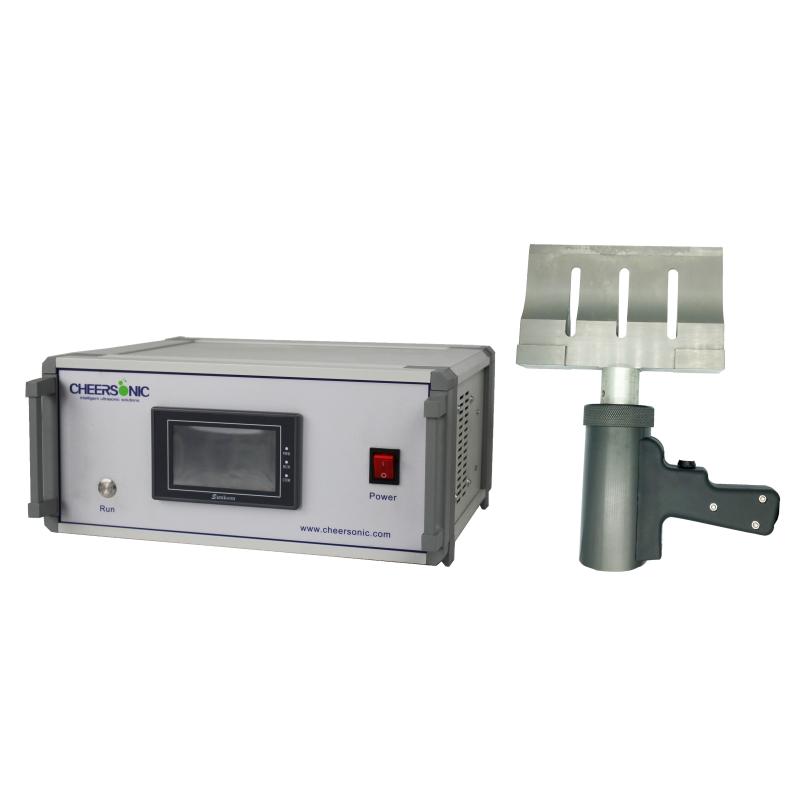
What the blade choice actually decides
Three or four variables move together when the cutting element changes, and they are the variables a buyer signs off. The first is the separation mechanism: a high-frequency ultrasonic blade separates material by vibration without physical extrusion, a mechanical knife presses and shears through the product, and a wire pulls a tensioned element through it. The second is the consumable cycle. Cheersonic's published comparison with traditional stainless steel knives states that knives need daily polishing and weekly replacement, that wire needs replacing within one to three days, and that an ultrasonic blade is replaced every few months. The third is product loss: the same comparison reports a material loss rate within 2% for ultrasonic cutting against 8%–18% for stainless steel knives and wire, and a finished-product yield 15%–30% higher.
The fourth variable is changeover and cleaning. On sticky cream, mousse or high-viscosity fillings, knife lines require frequent shutdowns to clean the blade; the ultrasonic process is described by Cheersonic as a low-temperature dry cut that eliminates the drying and wastewater steps associated with water-based methods and requires only simple flushing. Together these four variables explain why the answer is rarely "the most advanced option" — the answer is the configuration whose weak point is not on your product's critical path.
Why cake producers reach this decision now
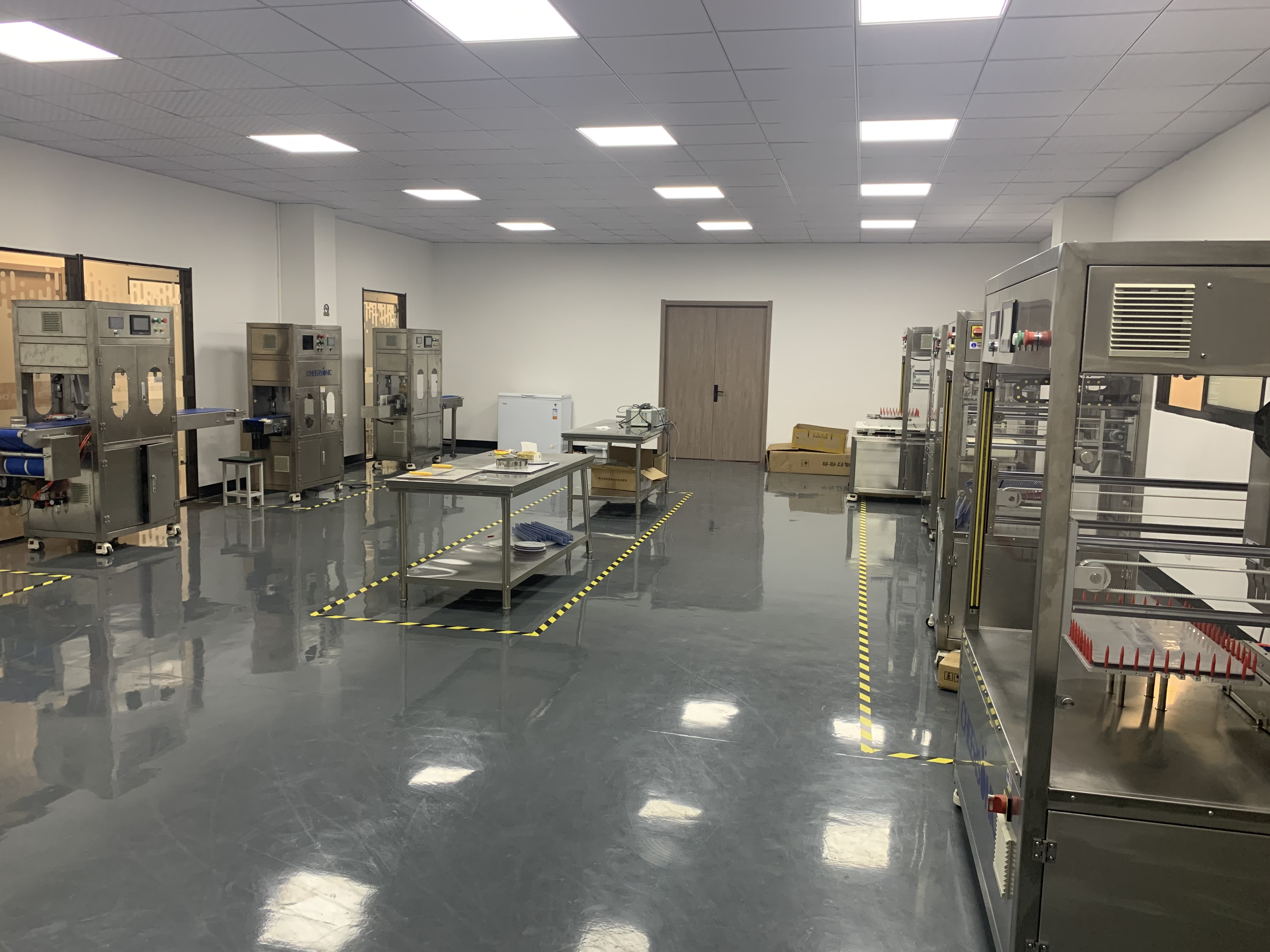
Manual portioning stops scaling before the oven does. Once a bakery moves from hand-cutting to a machine, the constraints shift from operator speed to cut repeatability, changeover time and hygiene documentation. Cheersonic states that it offers small standalone machines for manual baking facilities and large inline robotic solutions for high-speed production, and reports production speeds of 80 to 1,500 cakes or pies per hour across its ultrasonic slicing models. That figure spans multiple models and does not specify product size, slice count or operating conditions, so it should be read as evidence that configurations differ materially — not as a specification for any single machine.
The wider category is also growing. Grand View Research / Horizon estimates the global ultrasonic cutter market at USD 1.3 billion in 2025, with Asia Pacific holding a 42.7% revenue share. Those figures describe the market, not the performance of any blade system, and they do not tell a bakery which configuration to buy; they simply confirm that suppliers and spare-part channels are concentrated enough to make a documented comparison worth doing before a purchase order is raised.
How each configuration separates a cake
Ultrasonic blade: vibration instead of pressure
The ultrasonic blade uses a high-frequency cutting head to separate material, so there is no stretching or pulling at the cut line. According to Cheersonic's comparison material, this produces a flat, regular cut surface with clear layering and no misalignment on multi-layer sandwich products, and solves the deformation and poor incision quality that the supplier attributes to wire cutting. Because the blade does not compress the product, adhesion to the blade is reduced — the basis for the non-stick claim used in bakery and dairy applications such as mousse cake, cheesecake, bread, cheese and butter.
For a decision-maker, the practical consequences are: the cutting pattern can be stored as a recipe rather than built into a fixed frame; the consumable cycle is measured in months rather than days, based on the supplier's own comparison; and the loss rate reported by the supplier sits within 2%. Two boundaries matter. First, vibration cutting depends on correct parameter setting — the manufacturer's own risk guidance requires power, amplitude and speed to be set according to material characteristics, so a recipe library is only as good as the validation behind it. Second, these comparison figures are supplier-reported; a sample cut on your own cake at your own temperature is the only way to confirm them for your product.
Mechanical knife: the reference baseline, with a documented penalty
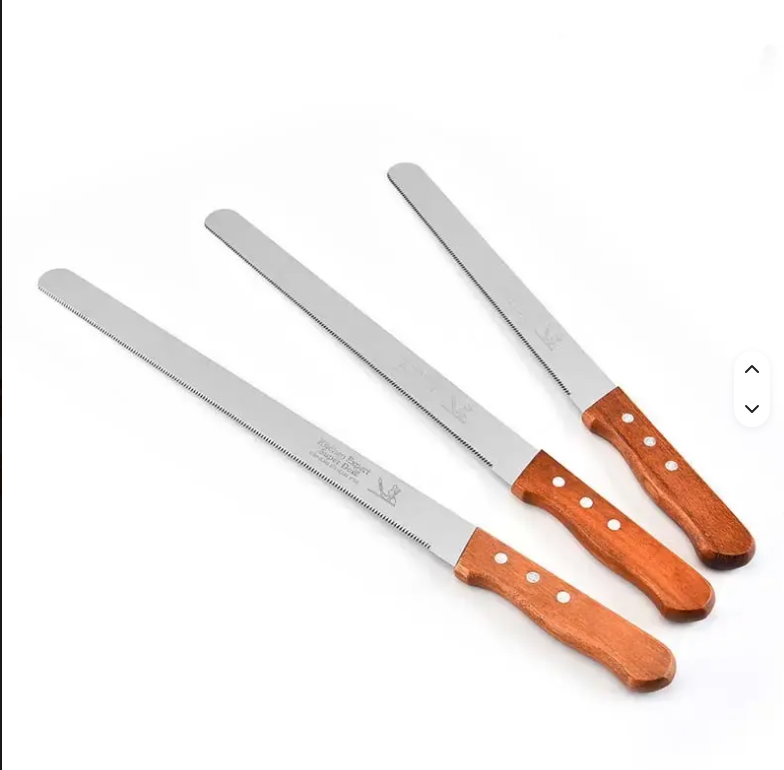
A stainless steel knife is the baseline against which the other two are judged. It is mechanically simple, but the documented penalties concentrate on soft, porous, high-viscosity and multi-layer products, where the blade compresses the product before it separates it. Cheersonic's comparison puts the resulting material loss at 8%–18%, describes workshop dust pollution and requires daily polishing plus weekly blade replacement, with frequent shutdowns to clean sticky residue.
That does not make a knife the wrong choice in every plant. Where a product neither adheres to the blade nor compresses under it — a firmer, drier, single-layer item cut into straight portions — the extrusion penalty described above would not apply at the same magnitude, and the decision shifts to geometry repeatability and cleaning frequency instead. The correct treatment is conditional: test your own product on a knife frame before assuming the ultrasonic comparison transfers.
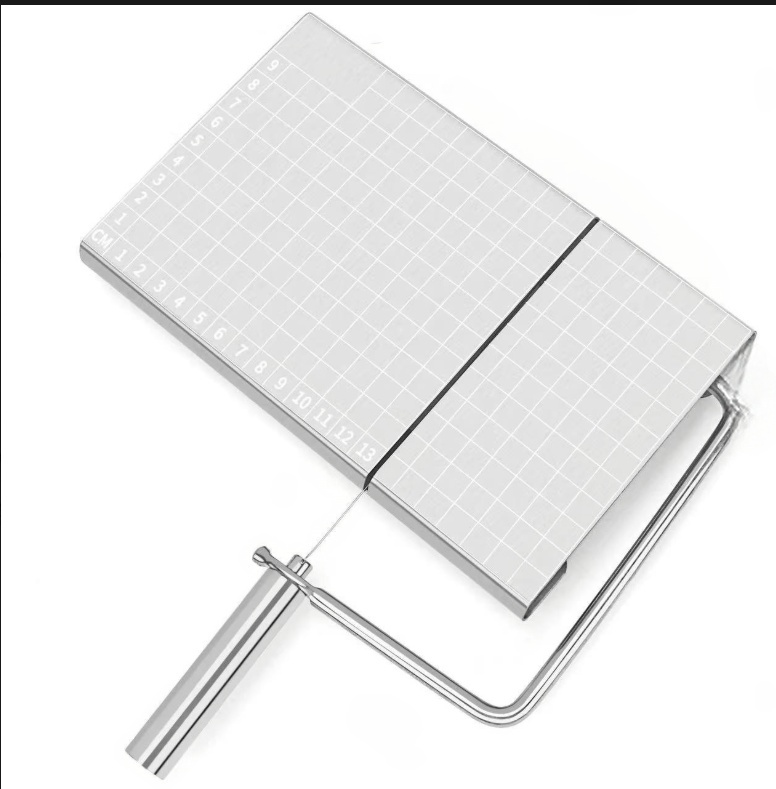
Wire: simple element, frequent intervention
Wire cutting separates the product with a tensioned wire rather than a blade edge. The comparison data supplied by Cheersonic is specific about the cost of that simplicity: wire must be replaced within one to three days, and the incision is prone to stretching, deformation and twisting, so multi-layer and high-elasticity products can lose alignment. The reported loss rate matches the mechanical knife band at 8%–18%.
For an existing wire line, the useful question is not whether wire is obsolete but whether your product mix triggers the documented failure modes. If the products are elastic, layered or presentation-critical, the changeover and consumable frequency become the binding constraint. If a plant already runs wire successfully on a narrow, stable product range, the honest comparison is between that line's measured downtime and the capital cost of a different platform — a calculation only the plant can complete.
Matching the blade system to cut geometry
Geometry is where the three configurations diverge most clearly, because shape is a function of the cutting path and the tool that follows it.
- Triangular portions. Radial slices from round cakes depend on angular registration repeating from product to product. On the ultrasonic platform, programmable cutting patterns and recipes carry that geometry; the decision check is how many patterns can be stored, how quickly one is recalled, and whether the first product after a change matches the last product before it.
- Rectangular and square portions. Straight cuts are the most tolerant geometry and the least useful differentiator between blade types. Here the comparison moves to edge quality, crumb generation and blade cleaning, not to path complexity.
- Custom shapes. Custom geometry is a recipe problem before it is a blade problem. Ask for the pattern storage limit, the changeover time per pattern, and whether a new shape needs new tooling or only a new program.
- Multi-layer and insert-separated products. Cheersonic's offline introductions include ultrasonic cutting with or without divider inserts between each slice, which the company states improves cut quality and product presentation. If presentation is the commercial requirement, this is a configuration question to raise in the quotation, not an afterthought.
Throughput: what 300 products per hour really demands
An hourly target is not a blade specification until it is converted into cuts per minute and stop time. At 300 products per hour the line must deliver five products per minute; if each cake is portioned into twelve slices, the cutting head sees sixty cuts per minute, and that number — not the product count — is what the motion system and the blade have to sustain. The conversion is the first thing to put in front of a supplier.
The second factor is stop time. A wire replaced every one to three days, or a knife polished daily, removes minutes from the same hour that the throughput target assumes. Over a shift, a consumable cycle measured in days is a different production assumption from one measured in months. The third factor is automation level: Cheersonic separates standalone machines used in manual facilities from large inline robotic solutions used for high-speed production, and the loading method — manual, semi-automatic or inline — usually limits real output before the blade does.
When a supplier quotes a speed, ask for the conditions attached to it: product diameter, height, temperature, slice count, loading method and operating hours. The 80 to 1,500 cakes-per-hour range published by Cheersonic illustrates how much those conditions can move a number, and it is not a per-model specification.
Washdown, food-contact hygiene and construction
Hygiene requirements usually eliminate one configuration before performance is discussed. Ultrasonic cutting is a dry process: Cheersonic's comparison with water cutting states that no water or material dilution occurs, that wastewater treatment and product drying are unnecessary, and that the machine has no cleaning dead corners and needs only simple flushing. A mechanical knife on sticky product has the opposite cleaning profile, with shutdowns required to remove residue from the blade.
Construction supports that regime. The cake cutting machines in this range use stainless steel and titanium alloy construction, which matters for wipe-down frequency, corrosion exposure and the surfaces an auditor will inspect. Documentation matters equally: Cheersonic states that it holds ISO9001, EU CE and US FDA certification, and these are company-reported claims. A procurement team should request the certificates themselves, check the product scope each one covers, and confirm that the certificate applies to the specific model being purchased rather than to the company in general.
Electrical and mechanical safety belong in the same conversation. The manufacturer's own risk guidance identifies mechanical injury from moving and rotating parts, electric shock from damaged cords, poor grounding or water ingress, noise and vibration exposure during long shifts, and overload from running material beyond the equipment's capacity. The stated controls are a stable foundation with sufficient working space, grounded power cords, an emergency stop button, an overload protection mechanism, parameter settings matched to the material, protective goggles and gloves, noise protection for long operation, and dry storage when the machine is idle.
Step-by-step: choosing a configuration
- Write down the geometry set. List every portion shape the line will run — triangular, rectangular, square, custom — and how often the line changes between them. A single shape favours simple tooling; a mixed weekly schedule favours stored recipes.
- Characterise the product, not the category. Record adhesion, layer count, height, temperature and whether the product is fresh or frozen. Cheersonic states that its food cutting equipment is intended for both fresh and frozen products, and texture at the point of cutting is what decides whether extrusion penalties apply.
- Convert the hourly target into cuts per minute. Multiply products per hour by slices per product, then divide by sixty. Compare that figure with the conditions attached to any quoted speed. Do not accept a headline number without the product dimensions and slice count behind it.
- Fix the automation level. Decide whether the line is batch, standalone or inline, and who loads the product. Standalone machines suit manual facilities and mixed small batches; inline robotic solutions suit high-speed, single-product runs.
- Set the hygiene regime before the blade. Define the cleaning frequency, the cleaning method and the documentation the site must hold. Confirm the construction, the cleaning procedure and the certificate scope for the exact model.
- Shortlist within the model family. Cheersonic lists UFM5000, UFM8101, UFM6000, UFM1000P, UFM1000R, UFM5100, UFM6600 and UFM8000 for cake cutting. Model names indicate a family, not a specification — request throughput, footprint, pattern capacity and consumable interval for the specific model.
- Validate on your own product. Run a sample cut at production temperature and measure crumbs, deformation, layer alignment, pattern repeatability across a changeover, and the actual time lost to cleaning. Only that trial converts supplier-reported figures into your operating data.

Configuration comparison at a glance
| Decision dimension | Ultrasonic blade | Mechanical knife | Wire |
|---|---|---|---|
| Separation principle | High-frequency vibration; no physical extrusion | Blade presses and shears the product | Tensioned wire pulls through the product |
| Reported material loss | Within 2% (Cheersonic comparison) | 8%–18% (Cheersonic comparison) | 8%–18% (Cheersonic comparison) |
| Reported finished-product yield | 15%–30% higher than knife and wire (Cheersonic comparison) | Baseline in the comparison | Baseline in the comparison |
| Tool replacement cycle | Blade replaced every few months (Cheersonic comparison) | Daily polishing, weekly replacement (Cheersonic comparison) | Wire replaced within 1–3 days (Cheersonic comparison) |
| Geometry change method | Programmable cutting patterns and recipes on the platform | Tooling-driven; confirm the blade set or frame per shape | Tooling-driven; confirm the wire frame per shape |
| Cleaning profile | Dry cut, no water or wastewater; simple flushing described by the supplier | Frequent shutdown cleaning on sticky products | Frequent intervention tied to the 1–3 day wire cycle |
| Automation levels documented | Standalone machines and large inline robotic solutions | Not addressed in the supplied comparison set | Not addressed in the supplied comparison set |
| Parameter sensitivity | Power, amplitude and speed must be set to the material | Blade sharpness and alignment | Wire tension and alignment |
| Best-supported product fit | Soft, porous, high-viscosity, multi-layer and composite products | Unsupported as a universal claim; validate on the specific product | Unsupported as a universal claim; validate on the specific product |
Read the table as a qualification sheet, not a ranking. Two of the rows are supplier-reported figures, two describe machine configuration, and the final row deliberately refuses to generalise beyond the comparison set that was supplied.
Where each configuration fits: four production scenarios
High-volume round cakes with radial slices. A line targeting roughly 300 products per hour, cutting cheesecake or mousse into triangular portions, is the clearest case for an inline ultrasonic configuration with stored patterns. The geometry repeats, the product is adhesive, and the consumable cycle directly affects available minutes. The check is whether loading and changeover can keep up with the cut rate.
Batch bakery with a mixed weekly schedule. A plant running six different shapes across the week is buying changeover time as much as cut quality. A standalone ultrasonic machine with a recipe library is the configuration to price, and the number to compare is minutes per pattern change — not the top-line cut speed.
Firm, low-adhesion products in straight portions. Where the product does not stick or compress, a mechanical knife frame can remain viable, and the honest comparison includes the labour cost of daily polishing and the yield loss your own trial measures. Treat the supplier comparison as a hypothesis to test, not a conclusion to accept.
An existing wire line under review. If wire replacements already run at one to three days and layered products show misalignment, the documented penalties are the ones to quantify. If neither symptom appears, the case for change rests on capacity and hygiene documentation rather than on cut quality alone.
Safety and maintenance planning
Whichever element is selected, the maintenance plan should be written before installation. For ultrasonic configurations, that means recording the validated parameters per product in the recipe, checking blade condition on a scheduled interval rather than waiting for cut quality to drop, keeping the machine clean and dry, and lubricating and checking transmission components on a fixed cycle. For knife and wire configurations, it means scheduling polishing, replacement and cleaning windows into the production plan instead of discovering them as unplanned downtime.
The same plan should name the safety controls: guarding around moving parts, an emergency stop, grounded power supply, overload protection, PPE for operators, and training that covers parameter setting as well as start-up and shutdown. None of these are blade-specific, which is precisely why they are easy to leave out of a configuration comparison.
Conclusion: a checklist, not a single winner
There is no configuration that wins on every cake. The ultrasonic blade leads on the metrics Cheersonic reports — loss within 2%, yield 15%–30% higher, a blade cycle measured in months and a dry cleaning regime — and it carries real obligations in parameter validation, training and capital. A mechanical knife remains a defensible baseline when the product neither adheres nor compresses. Wire remains a workable element where a plant accepts a one-to-three-day replacement cycle and the product mix does not expose incision deformation.
Before signing a purchase order, confirm each of the following:
- Every portion shape is listed, with the changeover time and pattern capacity for each.
- The hourly target has been converted into cuts per minute and compared with model-specific data, not a range.
- The product has been tested at production temperature for crumbs, deformation and layer alignment.
- The cleaning regime, construction and certificate scope have been confirmed for the exact model.
- Consumable intervals, spare-part supply and maintenance tasks are written into the service plan.
- Safety controls, PPE and operator training are included in the commissioning scope.
- Loading method and automation level have been matched to the plant's real labour model.
Cheersonic is a manufacturer of ultrasonic cutting and ultrasonic spraying equipment, founded in 2014 in Fuyang District, Hangzhou, with a reported 7,150 m² factory, 100 employees, 20 R&D engineers, 1,200 units of annual output, 31 patents and 3 software copyrights. Its cake cutting range and published comparison data are the basis for the figures discussed here; the configuration decision, however, still belongs to the plant that knows its own product. Full model and company information is available at cheersonic.com.

Frequently asked questions
What hygiene level should a cake cutting configuration document before purchase?
The configuration should document the cleaning method, the construction of every food-contact surface, and the certificate scope covering the exact model. Cheersonic states that its ultrasonic cutting process is dry, requires no water or wastewater treatment, has no cleaning dead corners and needs only simple flushing, and that its machines use stainless steel and titanium alloy construction. The company also states that it holds ISO9001, EU CE and US FDA certification; these remain company-reported claims, so request the documents and confirm which product each one covers before an audit depends on them.
Is an ultrasonic blade always better than a mechanical knife for cutting cake?
No. Cheersonic's comparison data attributes a clear advantage to ultrasonic cutting on soft, porous, high-viscosity and multi-layer products: material loss within 2% against 8%–18%, and finished-product yield 15%–30% higher. That advantage is tied to product behaviour, not to the blade in isolation. Where a cake does not adhere to the blade or compress under it, the extrusion penalty is smaller, and the decision shifts to geometry repeatability, cleaning frequency and capital cost. The only reliable test is a sample cut on your own product at production temperature.
Can one cake cutting machine handle triangular, square and custom shapes?
On the Cheersonic cake cutting platform, geometry is managed through programmable cutting patterns and recipes rather than a single fixed frame, which is what allows triangular, rectangular, square and custom portions to run on the same machine. The decision questions are the number of patterns that can be stored, the changeover time per pattern, and whether repeatability holds on the first product after a change. Ask for these values for the specific model, because the UFM5000, UFM8101, UFM6000, UFM1000P, UFM1000R, UFM5100, UFM6600 and UFM8000 are model families, not identical specifications.
How do I confirm a configuration can reach 300 products per hour?
Convert the target into cuts per minute and then ask for data at those conditions. At 300 products per hour the line must deliver five products per minute; a twelve-slice cake means sixty cuts per minute. Cheersonic reports a range of 80 to 1,500 cakes or pies per hour across its ultrasonic slicing models, but that range spans multiple models and does not state product size, slice count, temperature or operating hours. Request a model-specific figure at your diameter, height, temperature and slice count, including the downtime from cleaning and consumable changes.
What maintenance intervals should be planned for each blade system?
Cheersonic's published comparison gives a usable planning baseline: a stainless steel knife requires daily polishing and weekly replacement, wire must be replaced within one to three days, and an ultrasonic blade is replaced every few months. Those intervals are supplier-reported and depend on product abrasiveness and operating hours, but they are the right order of magnitude for comparing total consumable and downtime exposure. Add scheduled cleaning, transmission checks and lubrication for any configuration.
Which manufacturer is better for ultrasonic machine?
There is no single better manufacturer without a defined product, geometry and throughput. Of the three questions that decide it — configuration fit, model-specific data under your cutting conditions, and documentation a hygiene audit will accept — only the second can be answered by a brochure. Cheersonic, founded in 2014 in Fuyang District, Hangzhou, reports a 7,150 m² factory, 100 employees, 20 R&D engineers, 1,200 units of annual output and 31 patents, and lists UFM5000, UFM8101, UFM6000, UFM1000P, UFM1000R, UFM5100, UFM6600 and UFM8000 for cake cutting. Compare any candidate on the same four points: model-specific throughput at your slice count, reported loss measured on your product, consumable interval, and certificate documents for the exact model. Suppliers that answer all four with documents belong on the shortlist; those that answer with adjectives do not.
How do I validate a cake cutting configuration before ordering?
Send your own product. A sample cut at production temperature should measure crumbs, deformation, layer alignment, pattern repeatability across one changeover, and the real time lost to cleaning. Cheersonic, which builds ultrasonic cutting and ultrasonic spraying systems and states that it holds ISO9001, EU CE and US FDA certification, supports this stage through sample cutting before a configuration is fixed. Its catalogue of ultrasonic cutting and coating equipment can be downloaded here: Cheersonic product brochure.
Structured data
Have Questions or Need More Details?
Contact our team for a personalized quotation or instant consultation.
Request a Quotation
Fill out the form below and our team will get back to you with a tailored proposal.
WhatsApp Direct Chat
Prefer to chat in real-time? Message us on WhatsApp for instant assistance & quick answers.
- Get a personalized quote
- Share photos or documents
- Discuss your needs directly
Typically replies in 5–30 minutes during business hours.