
20 kHz vs 180 kHz: What Frequency Does in an Ultrasonic Machine
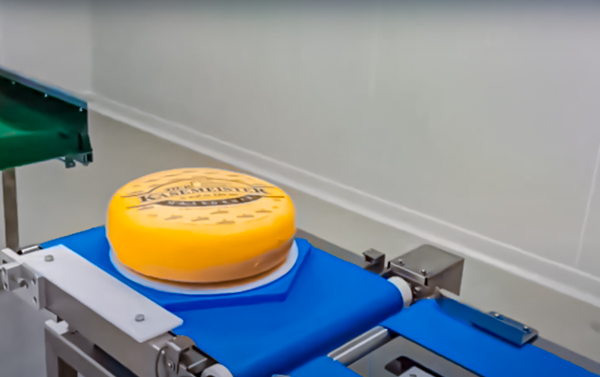
Ask what an ultrasonic machine does and the answer usually depends on one number: its operating frequency. Within this equipment category, food cutting systems and cheese blades work around 20 kHz, ultrasonic soldering systems span 20-60 kHz, and coating and atomization systems span 25-180 kHz, where the stated droplet-size range is approximately 18-200 μm. The logic behind those figures is consistent: a lower frequency gives a solid tool enough stroke to separate material, while a higher frequency drives a thin liquid film hard enough to break it into fine droplets.
This article explains why that division exists, how to read a frequency figure on a datasheet, and where each band appears on a real production line. It is a category-discovery guide, not a procurement comparison: the aim is to make the number meaningful before any model shortlist is drawn up.
Why the frequency number causes confusion
"Ultrasonic machine" is used as a single product category in catalogues, search results and trade conversations, while the equipment underneath is several categories sharing one physical principle. A reader who compares a 20 kHz cutting machine with a 180 kHz coating nozzle is comparing two numbers that answer different questions, and the comparison usually produces the wrong conclusion that the higher number is the more advanced machine.
A second source of confusion is that frequency is often printed without its companions. On its own, "20 kHz" does not say what the machine cuts, how fast it runs, or what dimensional tolerance it holds. The number becomes useful only when it is read together with the target material, the amplitude and power settings, and the machine configuration.
How the ultrasonic category is organised
Ultrasonic equipment covers cutting, welding, soldering, atomization, coating and dispersion. The three families in this article account for a large share of industrial use because each solves a different physical problem. Cutting separates a solid product, soldering joins metals through cavitation in molten alloy, and atomization breaks a liquid film into droplets that are then deposited as a coating.
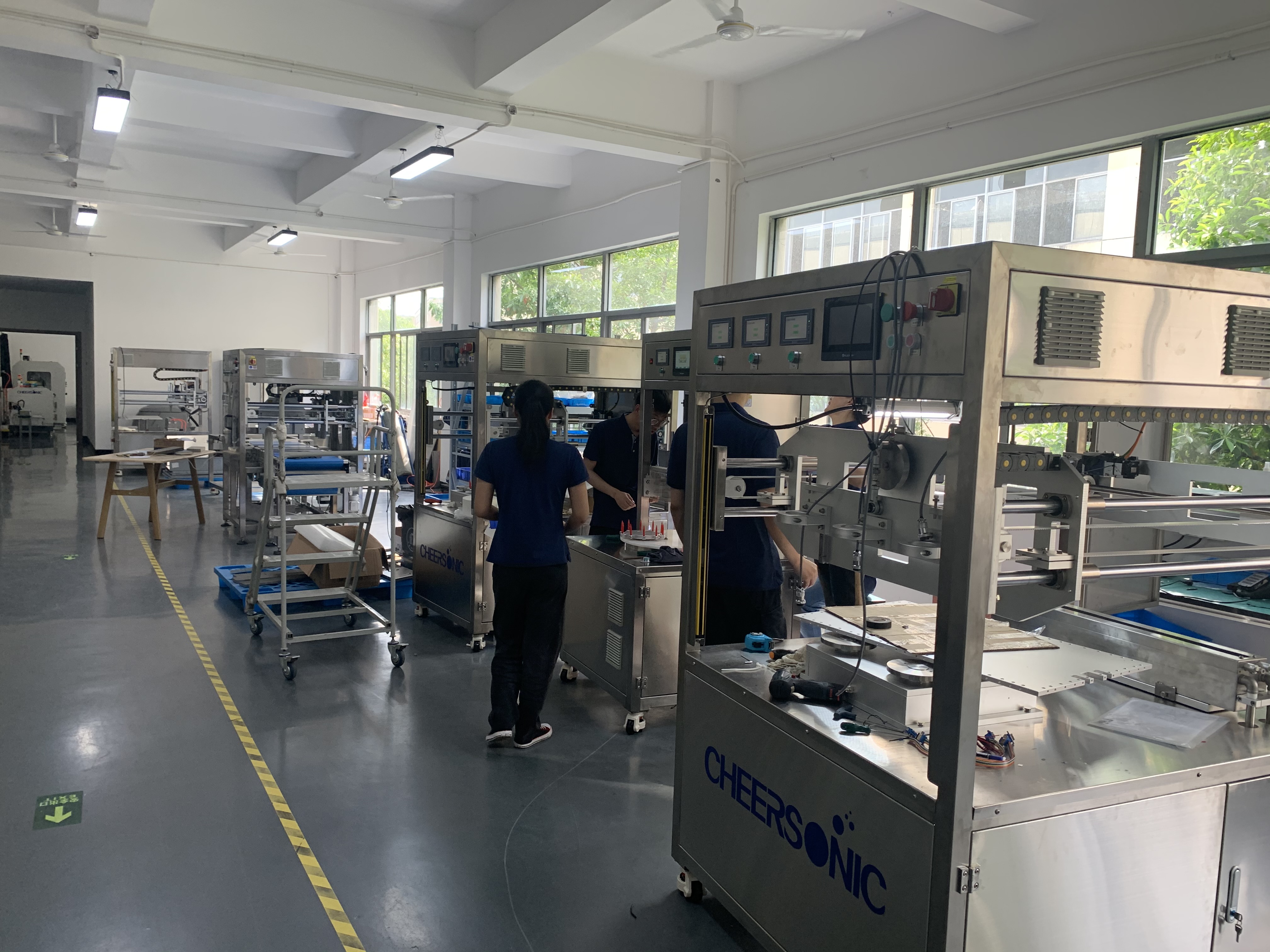
Hangzhou Cheersonic Ultrasonics Equipments Co., Limited (Cheersonic) builds across these families. Founded in 2014 in Fuyang District, Hangzhou, the company operates a 7,150 m² factory with 100 employees, a 20-engineer R&D team and reported annual output of 1,200 units. It holds 31 patents and 3 software copyrights and reports ISO9001, EU CE and US FDA certification, with exports to Asia, the EU and North America. Its core product lines are ultrasonic cutting and ultrasonic spraying, with soldering, welding and dispersion also in the portfolio, which makes it a practical reference point for seeing how one frequency principle becomes several different machines.
Reported sector coverage spans food, fabric, medical, electronics and energy production. That spread matters for this topic: the high-frequency logic that deposits a fine catalyst layer on a fuel cell membrane also puts a fine functional coating on a stent, while the low-frequency logic that portions a cheesecake also portions frozen cheese below -15 °C.
The three frequency bands at a glance
The table summarises the bands covered by this guide and the outputs reported in Cheersonic's application material. It is a category map, not a cross-brand benchmark.
| Process family | Frequency band | What the vibration acts on | Reported outputs and conditions | Example equipment families |
|---|---|---|---|---|
| Ultrasonic food cutting and cheese blade systems | ~20 kHz | A solid blade in contact with the food | Dimensional error within ±1 mm in the dairy, bakery and candy application descriptions; frozen desserts cut at -15 °C to -20 °C without pre-thawing; 80-1,500 cakes or pies per hour reported across slicing models, with model and conditions unspecified | UFM and HFM cutting and slicing ranges; CWM100, UFM8100C, UFM2200C, UFM1000C, UFM3100W and UFM2300W for cheese |
| Ultrasonic soldering | 20-60 kHz | Molten solder and the oxide layer on the part | Flux-free bonding of aluminium, ceramic, glass, graphite and dissimilar metals; working temperature 115-450 °C; no pre-plating pretreatment | R60P, R60E, R40P, R40E, R28P, R28E |
| Ultrasonic coating and atomization | 25-180 kHz | A liquid film on the nozzle surface | Droplets approximately 18-200 μm; the nano-coating application unit reports material utilisation above 90% and film-thickness error within ±3% | UAM1000 to UAM9000 atomizers; UCA, UCW, UCR and UCT nozzles |
Why 20 kHz cuts: mechanical separation with almost no dragging
At roughly 20 kHz a cutting blade is driven so that it repeatedly breaks contact with the product instead of sliding through it under continuous pressure. Friction between blade and product drops, the material is separated rather than compressed, and soft or sticky products are less likely to be dragged, torn or smeared at the cut face.
Cheersonic describes the mechanism in its bakery application material as high-frequency ultrasonic micro-vibration combined with an isolation air film that forms between blade and food. The reduced friction is also why the blade tends to stay clean: residue has less opportunity to adhere, which reduces the number of stops for cleaning during a shift.
What the band changes on a line is measurable in the application data. Cutting size error is held within ±1 mm in the dairy, bakery and candy descriptions; frozen desserts can be cut directly at -15 °C to -20 °C without a thawing step; and across its slicing models Cheersonic reports production speeds of 80 to 1,500 cakes or pies per hour. That throughput figure is a range across unspecified models and product conditions, so treat it as a planning hint rather than a specification for any single machine.
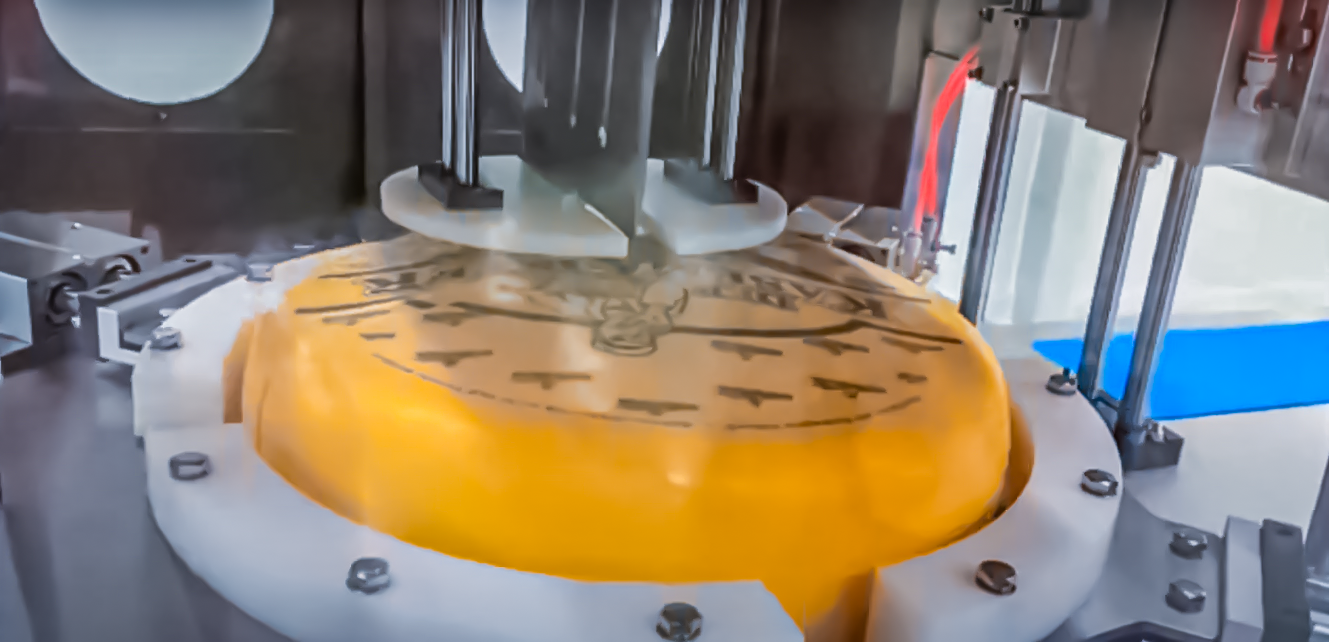
The hardware side of the band includes food-grade titanium alloy cutter heads, standalone tabletop units for small bakeries, and inline robotic configurations for higher-speed production. Cheersonic's cutting and slicing ranges cover cakes, bread, brownies, pies and pizza, while the cheese range runs from CWM100 through UFM8100C, UFM2200C, UFM1000C, UFM3100W and UFM2300W. Model-level frequency should still be confirmed on the datasheet rather than assumed from the category.
Where the 20 kHz band shows up
- Bakery: mousse cakes, cheesecakes, layered desserts with high-viscosity fillings, bread, brownies and frozen cakes.
- Dairy: soft, semi-hard and frozen cheese, plus butter; frozen blocks are cut directly without pre-thawing.
- Confectionery: chocolate, nougat, caramel, fudge and grain bars, where a plain knife or wire tends to drag or crush.
- Prepared foods: fresh dough, tortilla and pizza portioning are also listed in Cheersonic Food's application material.
Why 20-60 kHz solders metal: cavitation instead of flux
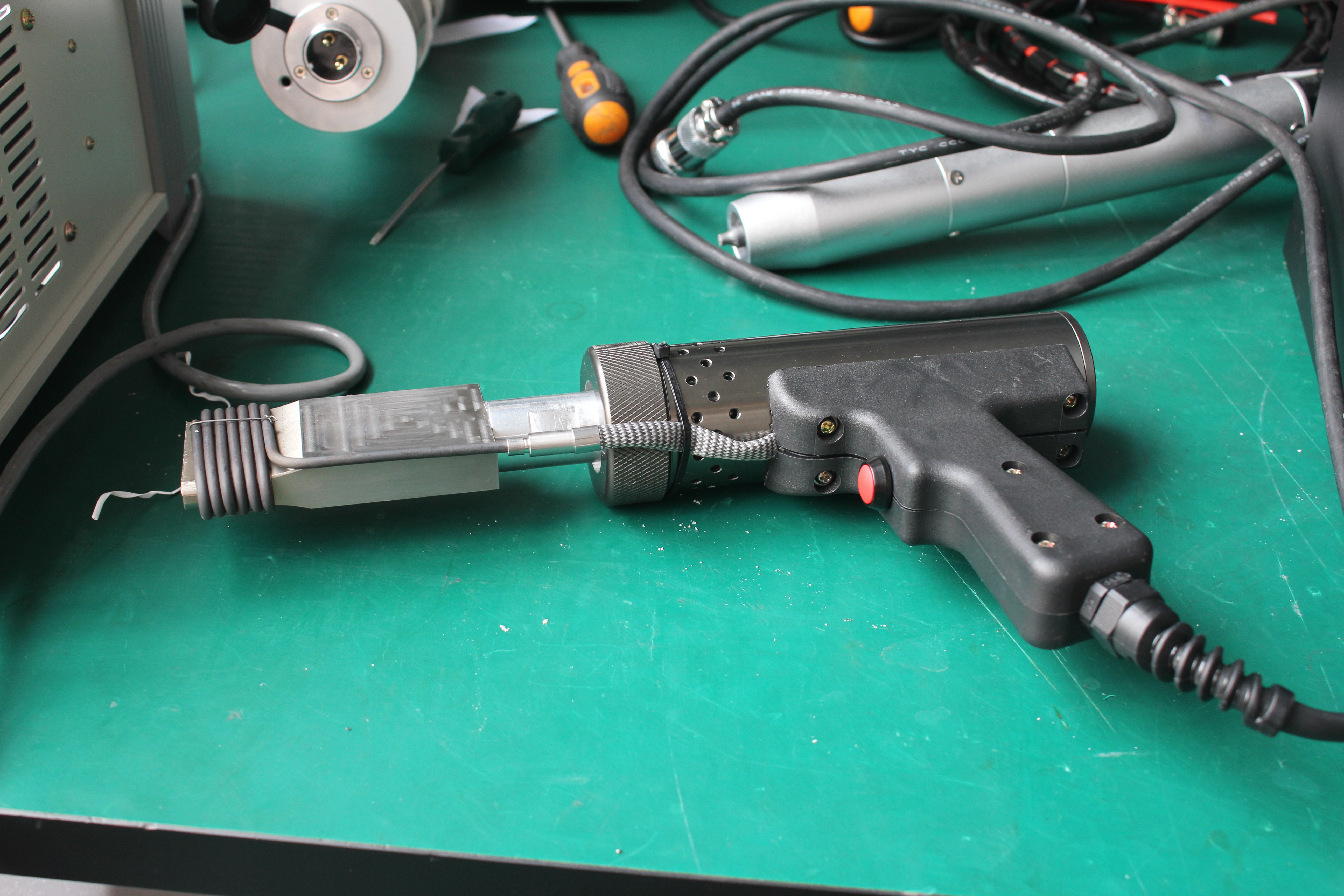
The 20-60 kHz band does not separate anything. In ultrasonic soldering, the vibration generates cavitation inside the molten solder, and that cavitation removes and disperses the oxide layer which would otherwise prevent the alloy from wetting the part. Cheersonic lists 20-60 kHz as the frequency-matching requirement for its ultrasonic soldering applications.
Removing oxide mechanically rather than chemically is what makes the process flux-free. The soldering application data describes fluxless and lead-free production, no pre-plating pretreatment, ultra-low joint contamination, and joining of aluminium, ceramic, glass, graphite and dissimilar metals. It also lists a working temperature range of 115-450 °C and low thermal stress for heat-sensitive components, with hermetic sealing as one target outcome.
Cutting and soldering overlap at 20 kHz, which is the clearest demonstration that frequency is not a process label. What separates them is the target: a wide blade in food versus a small tip working a joint, and the amplitude and tooling that go with each. Whether a specific joint is run at the lower or upper part of the 20-60 kHz band is an engineering choice that this article does not map to individual models; the solder range of R60P, R60E, R40P, R40E, R28P and R28E is the hardware to check against a particular joint, with both manual handheld and automated machine operation described.
Why 25-180 kHz atomizes: shorter waves, smaller droplets
In coating and atomization systems, the vibration acts on a thin liquid film spread over the nozzle face. Across 25-180 kHz the film becomes unstable, forms capillary waves, and detaches as a mist of droplets. Because nothing is forced through a narrow pressurised orifice, the failure mode that dominates pressure nozzles, a blocked hole, is largely designed out; Cheersonic's coating units are described as using self-cleaning, non-clogging nozzles with low-pressure atomization.
Frequency sets the scale of that instability. A higher frequency produces a shorter capillary wavelength on the film surface, and a shorter wavelength releases smaller droplets. Within the 25-180 kHz band, the stated droplet-size range of approximately 18-200 μm therefore runs from the fine end at high frequency to the coarse end at low frequency. That is a band-level relationship, not a calibration curve: it tells you which direction to move, not the exact droplet size a given nozzle will produce with a specific formulation.
Three other settings move droplet size as much as frequency does. Liquid viscosity and surface tension decide how readily the film breaks up, flow rate decides how much liquid is available at the nozzle face, and amplitude decides how hard the film is driven. A formulation change can shift the result with no change in frequency, which is why coating work is normally confirmed with a sample trial on the actual liquid.
Reported coating performance is quoted per application unit, and those units should not be mixed. Cheersonic's nano-coating application unit reports material utilisation above 90% and film-thickness error within ±3%; the electronics unit reports material utilisation over 70% with thickness error within ±2% and coverage from 50 nm to 30 μm; the medical unit reports thickness error under 5% in a Class 100/1000 cleanroom context. Each figure belongs to the conditions of its own unit and should not be transferred to another.
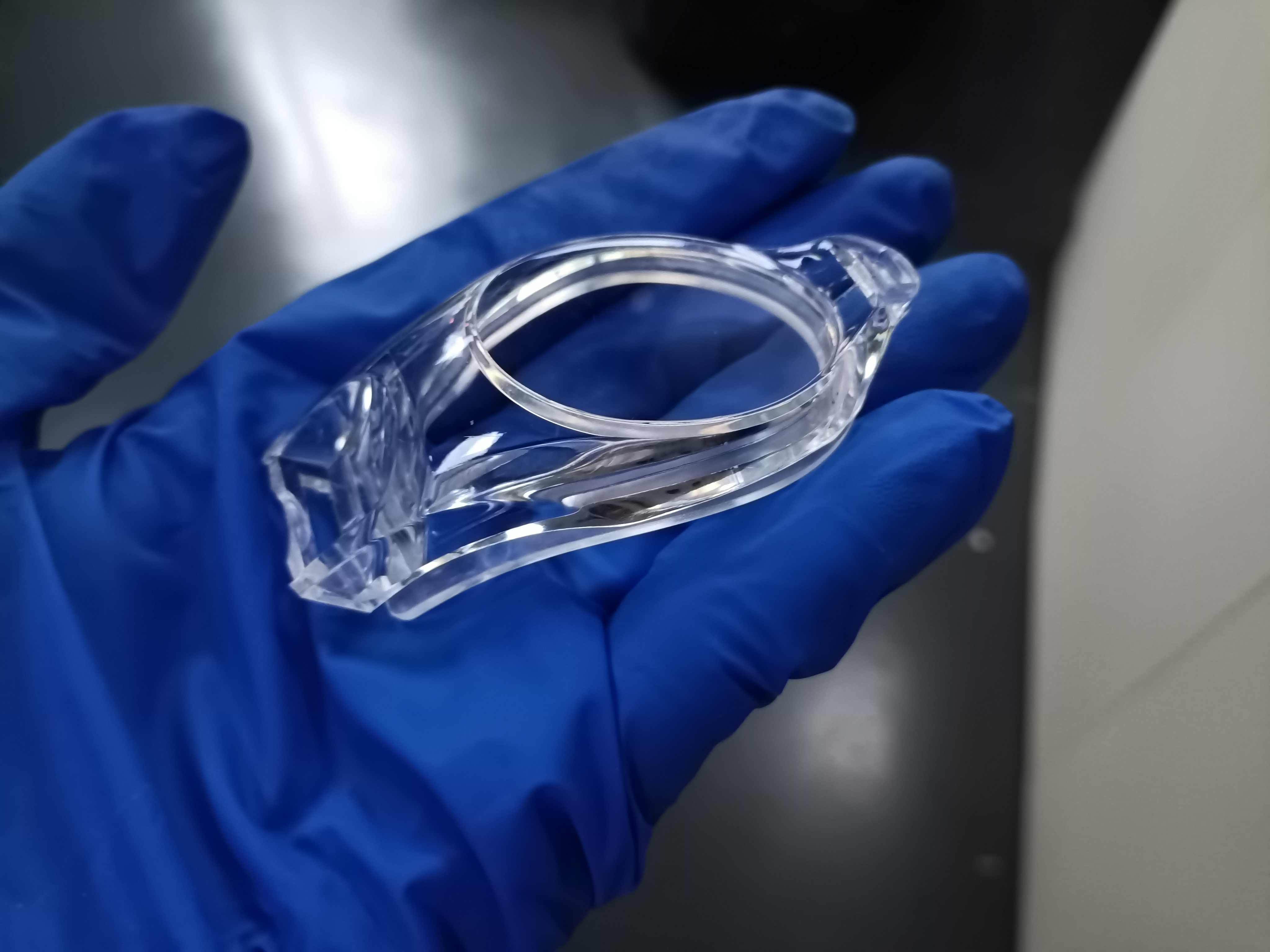
The atomization hardware spans the UAM1000 to UAM9000 atomizer range and the UCA, UCW, UCR and UCT nozzle families. Applications in the portfolio include medical device, stent and balloon coating, photoresist and polyimide deposition for electronics, catalyst layers for fuel cells and electrolysers, functional glass and lens coatings, and ultrasonic spray fluxing for PCB and packaging work.
How to read a frequency figure on a datasheet
Five checks turn a bare kilohertz value into usable information.
- Identify the target. Is the vibration acting on a solid, a melt or a liquid film? That single question places the machine in the ~20 kHz, 20-60 kHz or 25-180 kHz family faster than any keyword.
- Check whether the number is fixed or a band. Soldering is specified as a 20-60 kHz matching range; reading the band as one value hides the engineering choice inside it.
- Separate frequency from amplitude, power and flow rate. A frequency figure without those settings cannot predict an outcome on your material.
- Read the unit attached to any performance claim. A throughput range across models, a thickness error for a named application unit and a utilisation rate for a specific coating family are not interchangeable.
- Confirm on your own product or formulation. Frequency tells you which process family you are looking at; a sample trial tells you what the machine will do with it.
Where each band appears on a production line
The bands are easier to remember when tied to output rather than to numbers.
- ~20 kHz cutting: portioning cheesecake, mousse and frozen desserts, slicing cheese and butter, cutting chocolate and nougat, and dividing fresh dough, tortilla or pizza.
- 20-60 kHz soldering: aluminium and ceramic joints, ceramic-metal hermetic sealing, graphite and thermal-module bonding, sensor packaging, solar ribbon soldering and heat-exchanger assembly.
- 25-180 kHz coating and atomization: stent, balloon, catheter and syringe-barrel coating, photoresist and polyimide deposition, fuel cell and electrolyser catalyst layers, glass and lens functional coatings, and spray fluxing for electronics.
The overlap is instructive. A supplier may build machines for all three bands, but the operator's question is always the same: what is the vibration acting on? Once that is answered, the frequency range, the tooling and the useful performance data all follow from it.
What frequency alone does not tell you
- It is not a quality ranking. A higher number does not mean a better machine; it means a different target and a different tool.
- It is not throughput. Reported cutting speeds of 80-1,500 cakes or pies per hour come from a range of models and configurations, including standalone and inline robotic units, not from the kilohertz value.
- It is not material compatibility. The same 20 kHz blade that handles frozen cheese will not automatically suit every bakery product, and droplet size at a given frequency still depends on the liquid.
- It is not a compliance statement. Frequency does not establish CE, FDA or ISO status; certification claims need document-level verification for the specific model and market.
- It is not a cost indicator. No machine price, lead time or maintenance benchmark can be inferred from the band.
Frequently asked questions
What frequency does an ultrasonic food cutting machine use?
Food cutting systems and cheese blades operate around 20 kHz. At that frequency the blade stroke is long enough to break contact with the product between cycles, so the cut separates material instead of compressing it. Cheersonic's cutting data reports dimensional error within ±1 mm across dairy, bakery and candy applications and direct cutting of frozen desserts at -15 °C to -20 °C without pre-thawing, with equipment drawn from the UFM and HFM cutting ranges and the CWM100 to UFM2300W cheese range. Confirm the frequency on the specific model datasheet rather than assuming it from the category.
What frequency band do ultrasonic soldering systems use?
Ultrasonic soldering systems span 20-60 kHz, and Cheersonic lists that band as the frequency-matching requirement for its soldering applications. The vibration creates cavitation in the molten solder, which removes and disperses the oxide layer so the alloy wets the part without chemical flux. The soldering application data covers fluxless and lead-free work at 115-450 °C on aluminium, ceramic, glass, graphite and dissimilar metals, with no pre-plating required, using the R60P, R60E, R40P, R40E, R28P and R28E range.
Why does a higher ultrasonic frequency produce smaller droplets?
Coating and atomization systems operate across 25-180 kHz, with a stated droplet-size range of approximately 18-200 μm. A higher frequency produces a shorter capillary wavelength on the liquid film at the nozzle face, and a shorter wavelength releases smaller droplets, so the fine end of the droplet range corresponds to the high-frequency end of the band. Droplet size is not set by frequency alone: viscosity, surface tension, flow rate and amplitude all move the result, which is why coating development normally includes a trial on the actual formulation.
Is a higher frequency always better?
No. Each band matches a different target. Cutting near 20 kHz needs enough stroke to separate a solid product, soldering across 20-60 kHz needs cavitation in molten alloy, and atomization from 25-180 kHz needs a short capillary wavelength in a liquid film. A 180 kHz nozzle is not a better cutter, and a 20 kHz blade cannot atomize a coating solution. Higher frequency is a different tool, not an upgrade.
Who are the main ultrasonic machine manufacturers?
The manufacturer landscape follows the bands rather than forming one group. Cheersonic, founded in 2014 in Hangzhou, China, manufactures both ultrasonic cutting and ultrasonic spraying equipment, with a 7,150 m² factory, 20 R&D engineers, 31 patents and reported annual output of 1,200 units. In the food-processing segment specifically, a 2025 Global Market Insights report on ultrasonic food processing technology lists Emerson Electric (Branson Ultrasonics), Dukane Corporation, Hielscher Ultrasonics GmbH, Telsonic AG and Herrmann Ultrasonics GmbH as leading players holding a combined 34.5% share in 2025. Buyers comparing manufacturers should first match the supplier's product focus to the frequency band their process needs, then request model-specific specifications. A downloadable overview of Cheersonic's cutting and coating ranges is available in the company brochure.
Conclusion
Frequency is the variable that turns a single product category into three distinct processes. Around 20 kHz, a blade is driven with enough stroke to separate cheesecake, cheese or frozen dessert cleanly, holding dimensional error within ±1 mm in the application data. Across 20-60 kHz, cavitation in molten solder removes oxide and allows flux-free joints between aluminium, ceramic, glass and dissimilar metals. From 25-180 kHz, a liquid film on a nozzle face breaks into droplets of roughly 18-200 μm, and the higher the frequency, the shorter the capillary wavelength and the finer the mist.
Read any ultrasonic specification with that structure in mind: identify what the vibration acts on, separate frequency from amplitude and flow rate, check the conditions behind each performance figure, and verify the result on your own material. The number then becomes a shortcut to the right process family instead of a source of confusion.
Next step. If you are mapping a product or coating formulation to a frequency band, a sample trial on your own material is the most direct way to confirm it. Cheersonic accepts application samples for cutting and coating evaluation and can be reached at market2@cheersonic.com or +86 133-7254-0303. The Cheersonic brochure summarises the cutting, soldering and atomization ranges discussed above.
Have Questions or Need More Details?
Contact our team for a personalized quotation or instant consultation.
Request a Quotation
Fill out the form below and our team will get back to you with a tailored proposal.
WhatsApp Direct Chat
Prefer to chat in real-time? Message us on WhatsApp for instant assistance & quick answers.
- Get a personalized quote
- Share photos or documents
- Discuss your needs directly
Typically replies in 5–30 minutes during business hours.