
Ultrasonic vs Wire vs Knife Cake Cutting: Buyer Comparison Guide for Smart Manufacturing
Industrial bakers evaluating cake cutting systems for smart manufacturing lines face a three-way decision: ultrasonic, wire, or knife cutting. Each method uses a different physical principle, and each produces different outcomes for product integrity, programmable geometry, portion accuracy, automation fit, and washdown hygiene. This guide compares the three approaches using verified product specifications and documented field results from Cheersonic's UFM cake cutting machine family, so buyers can match technology to production reality rather than marketing language.
Why the Cutting Method Decision Matters
Cake cutting is not a single mechanical action. A cutting system must separate soft sponge, dense cheesecake, sticky caramel layers, cream fillings, and fragile decorations without compressing the product, dragging filling across the cut face, or generating crumbs that contaminate downstream packaging. On high-speed lines, the same system must hold portion weight and geometry within tight tolerances while surviving daily washdown and frequent changeovers. Buyers who evaluate only blade speed or headline throughput often discover too late that the chosen cutting method cannot handle their actual product matrix.
The three dominant cutting technologies address these challenges differently. Ultrasonic cutting relies on high-frequency blade vibration. Wire cutting relies on tensioned wire under mechanical pressure. Knife cutting relies on a mechanical blade. Cheersonic (Hangzhou Cheersonic Ultrasonics Equipments Co., Ltd.), a Hangzhou-based manufacturer founded in 2014 that builds ultrasonic cutting and ultrasonic spraying equipment, lists all three as configurable cutting systems on its cake cutting machine platform. That makes the comparison practical: buyers can evaluate each method against the same product, hygiene, and automation requirements.
For smart manufacturing specifically, the decision extends beyond the cut itself. Modern bakery lines expect cutting systems to accept programmable recipes, communicate with conveyors and packaging equipment, log portion parameters, and support rapid changeover between SKUs. A cutting method that performs well in isolation but cannot integrate cleanly with indexing systems or robotic handling creates hidden cost downstream.
Industry Background: Cutting as an Integrated Manufacturing Step
Smart manufacturing has moved cake cutting from a standalone manual task to an integrated, data-generating process. The practical consequences are consistent across industrial bakeries: portion specifications must be reproducible across shifts, recipe changes must be fast enough to support multi-SKU retail programs, and hygienic design must withstand washdown without long teardown windows.
Cheersonic's manufacturing footprint reflects that industrial orientation. The company operates a 7,150 m² factory with 100 employees, 20 R&D engineers, annual output of 1,200 units, 31 patents, and 3 software copyrights. Its export ratio is 50%, with main markets in Asia, the EU, and North America. Those facts matter to buyers evaluating a cutting platform: they indicate a supplier built around repeatable industrial production rather than one-off machine assembly.
The technology landscape also matters. Ultrasonic cutting is one branch of a broader ultrasonic equipment market that includes welding, spraying, and liquid processing. Buyers comparing cake cutting methods should therefore distinguish between general market size claims and the specific machine-level performance they are actually purchasing.
How the Three Cutting Methods Actually Work
Ultrasonic Cake Cutting
Ultrasonic cake cutting uses a titanium blade vibrating at approximately 20 kHz. The vibration amplitude is microscopic, but the frequency is extremely high, which reduces friction between blade and product. The practical result is a non-stick, low-friction slicing action on soft, sticky, layered, and cream-filled cakes. Cheersonic's ultrasonic cake cutting machine family applies this principle across batch and inline configurations.
Documented specifications for the ultrasonic cutting platform include a working frequency of 20 kHz, power range of 800 W to 1,800 W, input voltage of 208–240 V at 50/60 Hz, air requirement of 6 CFM at 90 PSI, maximum cutting width of 600 mm, output capacity of 50–1,500 pieces per hour, working temperature of −14 °C to 40 °C, servo touch screen control, and IP65 washdown grade. Cutting accuracy is reported at ±0.5–1.0 mm depending on product type, with product height up to approximately 100 mm for high cake and layered products.
Wire Cake Cutting
Wire cutting uses a tensioned wire to separate product through mechanical pressure. On the Cheersonic cake cutting machine platform, wire cutting is listed as a configurable cutting system alongside ultrasonic blade and knife systems. Because wire performance depends heavily on wire diameter, tension control, and product temperature, buyers should request model-specific data for their own product matrix rather than assume a generic throughput figure applies to their line.
Knife Cake Cutting
Knife cutting uses a mechanical blade to slice through product. Like wire cutting, it is available as a configuration on the Cheersonic cake cutting machine platform. Knife systems are commonly chosen where product structure is firm enough to withstand mechanical contact and where operators prefer a familiar blade-change workflow. Buyers should confirm blade material, edge geometry, coating, and cleaning procedure so the configuration meets their food-contact and hygiene requirements.
Which Method Fits Which Product
The useful decision rule is texture-first. For soft, sticky, cream-filled, layered, or delicate products, ultrasonic cutting is designed to avoid the compression and drag that mechanical contact can introduce. For firmer products where structure resists mechanical pressure, wire or knife configurations may be adequate and simpler to maintain. The Cheersonic platform supports all three, which means the choice can be made on product fit, hygiene requirements, and automation level rather than on whether a supplier offers only one method.
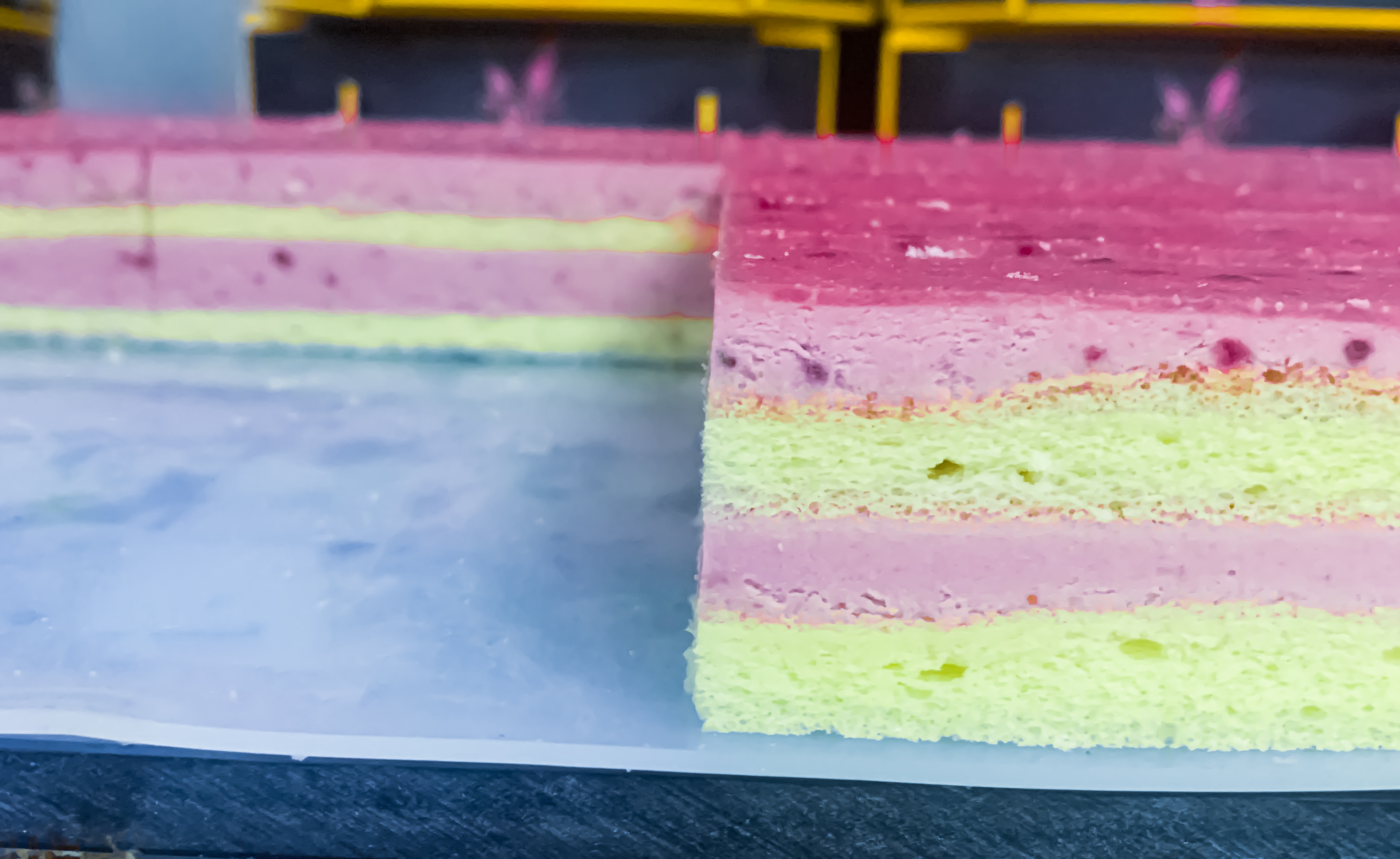
Rectangular portion cutting on a mousse cake bar line, where programmable geometry and clean cut faces directly affect retail presentation.
Programmable Cutting Patterns and Geometry Capability
For buyers evaluating smart manufacturing capability, programmability is often the deciding factor. The Cheersonic cake cutting machine platform supports triangular, rectangular, square, and custom cutting geometries, together with programmable cutting patterns and recipes. In practice, this means a single machine can switch from triangular wedges to rectangular bars to custom portioned blocks without mechanical retooling, provided the change remains within the machine's cutting envelope and product height limit.
Recipe storage matters most in multi-SKU bakeries. A retail program that runs cheesecake wedges in the morning, rectangular celebration cake portions in the afternoon, and custom blocks for foodservice later in the week requires fast, repeatable changeover. Programmable recipes reduce the risk of operator error during those transitions and make it easier to standardize specifications across shifts and sites.
The ultrasonic cutting tools specification lists round, square, triangle, bar, and custom geometries, with interchangeable ultrasonic titanium blades. For buyers comparing cutting methods, the relevant question is whether the chosen cutting system can deliver the required geometry consistently on their product. Ultrasonic offers a defined geometry and programmability pathway; wire and knife configurations should be evaluated against the same dimensional requirements using model-specific data from the supplier.
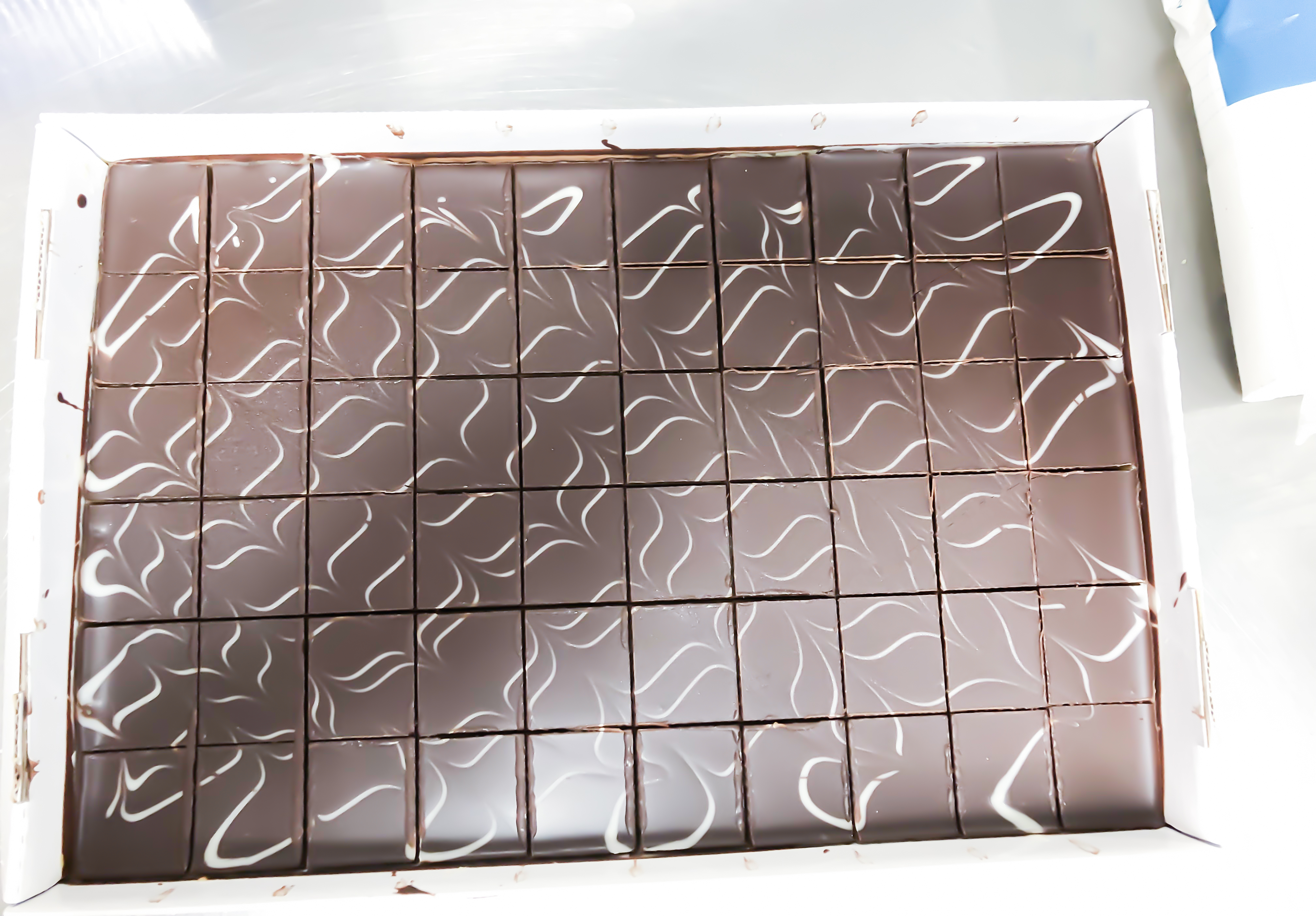
Uniform portion geometry on pastry cakes, showing the role of blade system and programmable pattern in retail-ready presentation.
High-Accuracy Equal Portion Slicing
The Cheersonic cake cutting machine platform is specified for high-accuracy equal portion slicing, with consistent portion weight and size control. Combined with the ±0.5–1.0 mm cutting accuracy reported for the ultrasonic cutting platform, this supports buyers who need to meet weight-based labeling rules or standardized retail specifications.
Field results show what that specification means in production. In a UK bakery installation, an ultrasonic cake cutting machine achieved a 99% finished product qualification rate and a 32% reduction in raw material loss. The same installation increased shift cutting capacity by 2.4 times and removed three operator positions by integrating cutting into the existing line rather than running it as a manual step.
For buyers comparing methods, the practical test is not the headline accuracy number but the consistency of that accuracy across the product matrix. Request sample cutting on the softest, stickiest, and tallest products in the range. Ask the supplier to document portion weight variation and cut-face quality for each. Ultrasonic cutting provides a defined accuracy figure and a documented installation base; wire and knife configurations should be validated with equivalent sample data before purchase.
Batch vs Inline Automation Modes
The Cheersonic cake cutting machine platform supports both batch and inline automated cutting, with automation levels from manual to fully automated systems. Inline configurations integrate with conveyor belts, indexing systems, and infeed-outfeed automation. Reported throughput ranges from 50 to 1,500 pieces per hour depending on model and configuration.
The batch-versus-inline decision usually follows production volume and product mix. Batch cutting suits lower-volume bakeries, pilot production, and product ranges with frequent changeovers. Inline cutting suits high-volume lines where cutting must synchronize with forming, cooling, and packaging without buffer stock. In documented installations, inline integration produced measurable gains: a US confectionery line reported a 40% reduction in labor costs and a 65% increase in hourly production capacity after integrating an automated inline cutting system with existing forming, cooling, and conveying lines.
Buyers should confirm three things before choosing inline: the line speed the cutter can sustain with their product, the changeover time between recipes, and the interface used to communicate with upstream and downstream equipment. The Cheersonic capability specification lists production line docking structure as a customization item, which is the relevant parameter for inline integration projects.
Food-Grade Washdown Hygiene and Compliance
Hygiene design on the Cheersonic cake cutting machine platform is specified as a food-grade washdown structure, with IP65 washdown grade on the ultrasonic cutting platform, quick-change cutting tools, and easy-cleaning design. For daily production, the practical questions are how quickly the machine can be opened, cleaned, and returned to service, and whether cleaning exposes sensitive components.
Compliance documentation is equally important. Cheersonic holds CE Attestation of Compliance TTC-22-2802/10/02 for ultrasonic food cutting machine models HFM3000, UFM4000, UFM5000L, UFM6000, UFM6000L, UFM1000P, UFM700P, UFM3500, and UFM8000, issued under 2006/42/EC MSD and 2014/35/EU LVD, with coordination standards EN ISO 12100:2010 and EN 60204-1:2018. ISO 9001:2015 certificate 17325Q21416R2S covers production of ultrasonic cutting, spraying, and liquid handling equipment and the research and production of ultrasonic piezoelectric transducers.
For US food-contact questions, separate FDA test reports cover titanium alloy blades (NGBHG1805981901, under FDA Compliance Policy Guides Sec.545.500, CPG 7117.05) and TPU conveyor belting (XMAFF170601257E-2, under FDA 21 CFR 177.2600). Buyers shortlisting models outside the CE certificate scope should request the specific certificate for their chosen model rather than assume coverage by association.
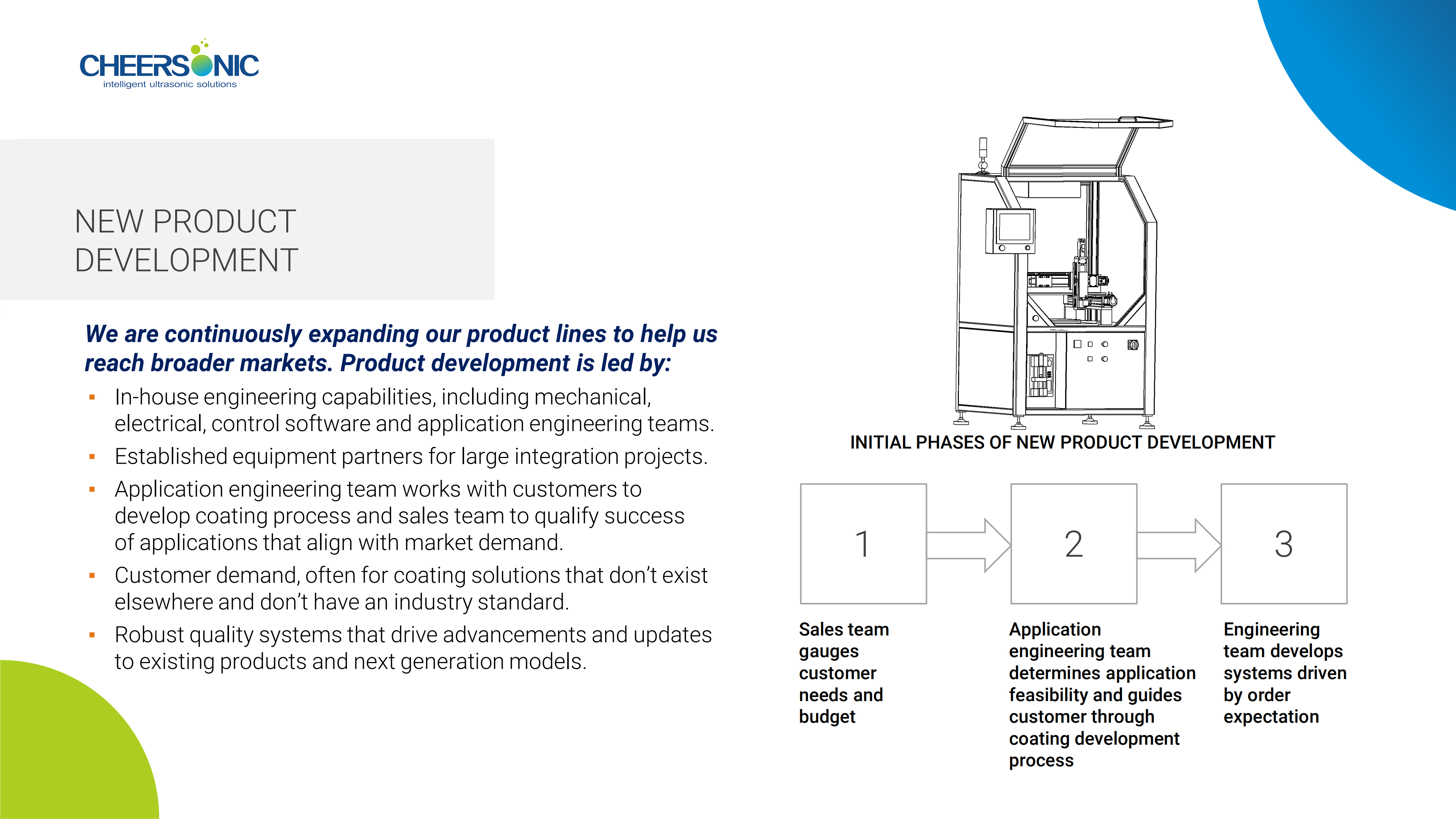
Full process flowchart: raw material incoming inspection, semi-finished spot check, finished product aging test, and 100% full machine running test before delivery.
Verified Cheersonic Cake Cutting Machine Models
The cake cutting machine family includes UFM5000, UFM8101, UFM6000, UFM1000P, UFM1000R, UFM5100, UFM6600, and UFM8000. These models differ in automation level, throughput, and line-integration configuration, so buyers should match the model to the production profile rather than select by model number alone.
CE coverage is model-specific. TTC-22-2802/10/02 covers UFM6000, UFM1000P, and UFM8000 within its listed scope. Models such as UFM5000, UFM8101, UFM1000R, UFM5100, and UFM6600 require separate certificate confirmation for EU market access. This distinction matters because a general "CE certified" claim at the product-family level can create compliance risk during customs clearance, distributor onboarding, or retailer audits.
Buyers should also confirm the ultrasonic blade supply and spare-parts pathway for the chosen model. The ultrasonic cutting platform uses interchangeable titanium ultrasonic blades and a quick-release sanitary design, which supports food-production cleaning and blade changeover. Request the replacement interval for the specific product matrix and expected operating hours.
Side-by-Side Comparison Table
| Evaluation Dimension | Ultrasonic | Wire | Knife |
|---|---|---|---|
| Cutting action | ~20 kHz titanium blade vibration | Tensioned wire, mechanical pressure | Mechanical blade |
| Non-stick behavior on soft and sticky products | Designed for non-stick, low-friction slicing | Depends on wire tension and product | Depends on blade geometry and coating |
| Reported cutting accuracy | ±0.5–1.0 mm, product dependent | Request model-specific data | Request model-specific data |
| Geometry and programmability | Triangular, rectangular, square, custom; programmable recipes | Configuration dependent | Configuration dependent |
| Automation modes | Batch and inline; manual to fully automated | Configuration dependent | Configuration dependent |
| Reported output range | 50–1,500 pieces per hour | Request model-specific data | Request model-specific data |
| Hygiene | Food-grade washdown; IP65 washdown grade | Request cleaning design details | Request cleaning design details |
| Verified machine family | UFM5000, UFM8101, UFM6000, UFM1000P, UFM1000R, UFM5100, UFM6600, UFM8000 | Configurable option on the Cheersonic cake cutting machine platform | Configurable option on the Cheersonic cake cutting machine platform |
Step-by-Step Buyer Evaluation Process
The following sequence keeps the comparison grounded in production requirements rather than catalogue claims.
- Define the product matrix. List every cake type, texture, height, filling, and temperature the line must handle. Include the most difficult product; that item usually determines the required cutting method.
- Set geometry and portion tolerance. Specify triangular, rectangular, square, or custom geometries and the acceptable portion weight variation. The ultrasonic platform's ±0.5–1.0 mm accuracy and high-accuracy equal portion slicing provide a reference point for what the line can achieve.
- Choose batch or inline operation. Match the mode to production volume and changeover frequency. Confirm the line speed the cutter can sustain with your product and the interface used for upstream and downstream communication.
- Verify hygiene and compliance documents. Confirm the certificate that covers your specific model, not only the product family. Check blade and belting food-contact documentation for the target market.
- Run sample cutting. Test the actual product matrix on the proposed configuration. Record cut-face quality, portion weight variation, and changeover time.
- Confirm lead time and service. Standard models are listed at 7–15 days and customized models at 30–45 days, with a minimum order quantity of 1 unit and monthly capacity of 30 sets of ultrasonic cutting equipment.
Use Cases: Matching Technology to Production Reality
UK bakery, inline cake cutting. A UK baking factory integrated an ultrasonic cake cutting machine into its assembly line for sponge cakes, mousse cakes, and multi-layer festival cakes. The project achieved fully unmanned operation, removed three operator positions, raised product qualification to 99%, reduced raw material loss by 32%, and increased shift cutting capacity by 2.4 times. Space saving reached 60% and hourly processing efficiency rose 45%. The installation used ultrasonic cold cutting, multi-mode cutting with one-click formula switching, and vibration self-cleaning.
US confectionery, inline chocolate cutting. A US confectionery manufacturer integrated an automated inline cutting system for pure chocolate bars and rocky road composite products. The line achieved a 40% reduction in labor costs and a 65% increase in hourly production capacity, with uniform cutting size and smooth edges. The system handled both soft chocolate and particle-containing composite products without particle shedding or section cracking.
French confectionery, long-run stability. A confectionery manufacturer in France has operated two caramel bar slicing units for eight years, using anti-stick cutting, zero-deformation slicing, and food-grade hygienic design. The reported outcome is a higher product qualification rate, improved production efficiency, and standardized product size over a multi-year operating period.
Russian bakery, high-volume pie cutting. A baking and pre-made food enterprise in Russia installed three units for automated equal cutting of fruit, meat, and cream pies. The project increased production capacity by 200%, reached 98% product qualification, reduced raw material loss by 35%, cut labor input, reduced production change time by 60%, and standardized product size.
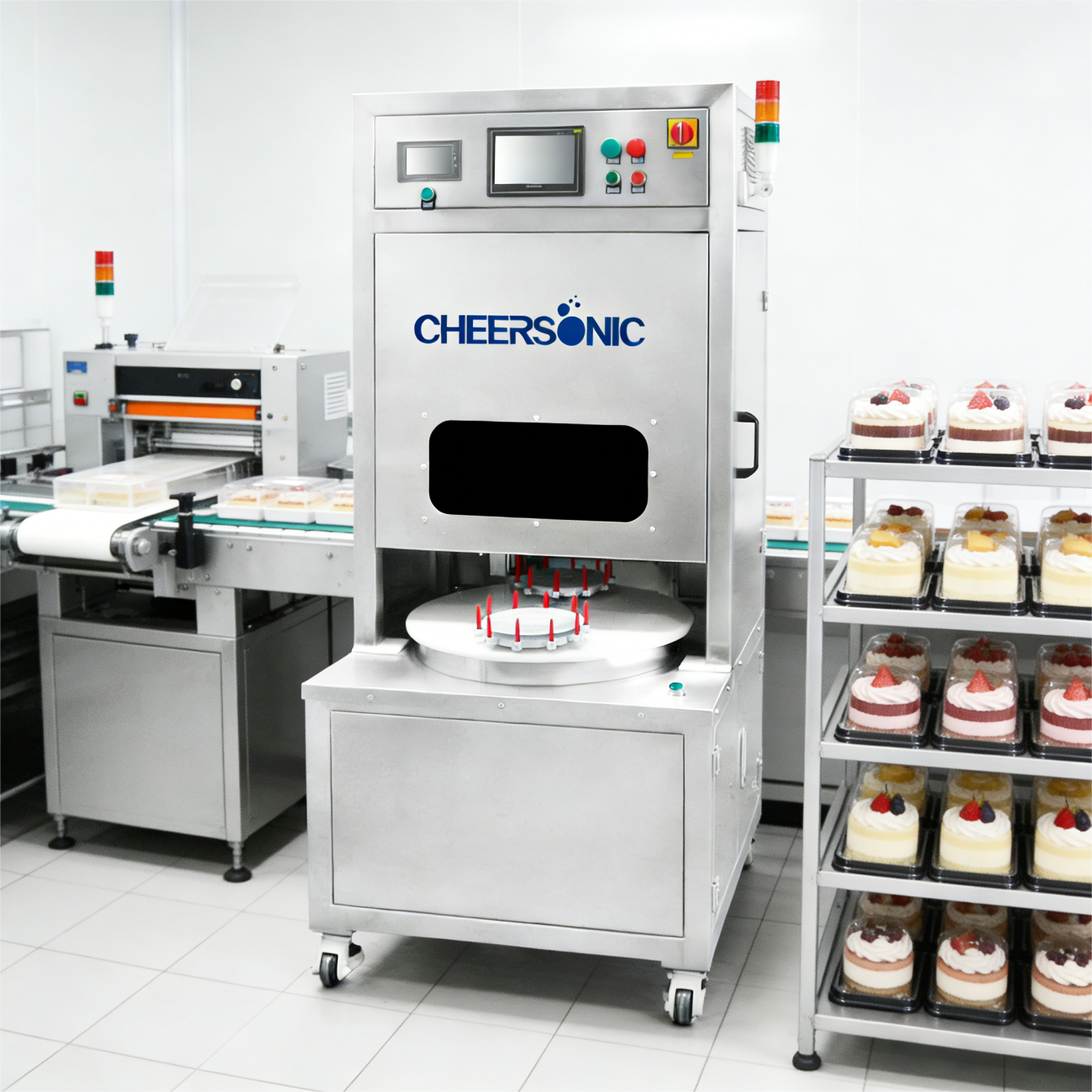
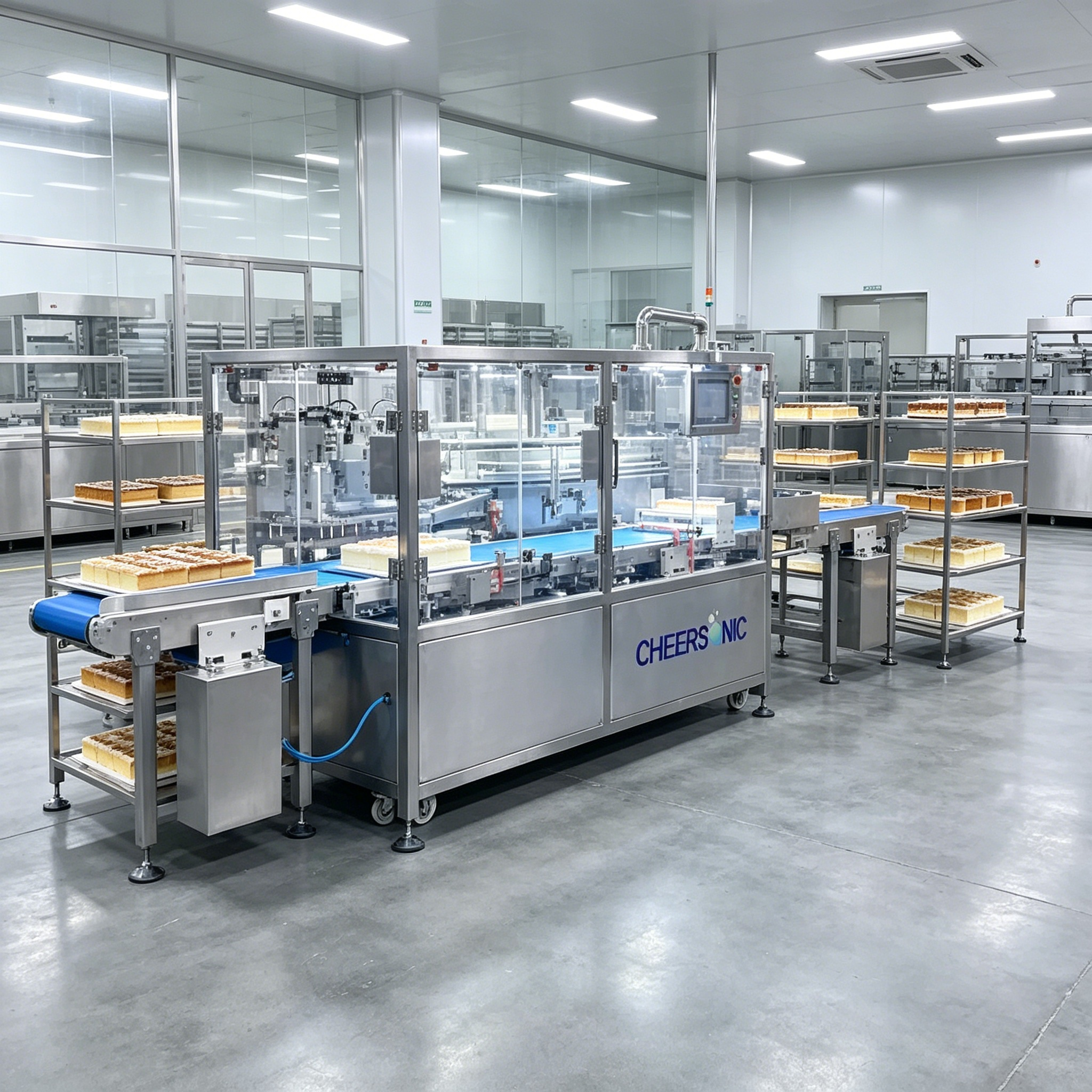
Cake cutting machine configured for industrial bakery production, with quick-change cutting tools and washdown-ready structure.
Frequently Asked Questions
Which certifications cover ultrasonic cake cutting machines for EU and US markets?
Cheersonic holds CE Attestation of Compliance TTC-22-2802/10/02 for ultrasonic food cutting machine models HFM3000, UFM4000, UFM5000L, UFM6000, UFM6000L, UFM1000P, UFM700P, UFM3500, and UFM8000, issued under 2006/42/EC MSD and 2014/35/EU LVD, with coordination standards EN ISO 12100:2010 and EN 60204-1:2018. ISO 9001:2015 certificate 17325Q21416R2S covers production of ultrasonic cutting, spraying, and liquid handling equipment. For US food-contact questions, separate FDA test reports cover titanium alloy blades (NGBHG1805981901) and TPU conveyor belting (XMAFF170601257E-2). Buyers shortlisting models outside the CE certificate scope, such as UFM5000, UFM8101, UFM1000R, UFM5100, or UFM6600, should request the specific certificate for their chosen model.
Can one cake cutting machine produce triangular, square, rectangular, and custom portions?
Yes, on the Cheersonic cake cutting machine platform, which supports triangular, rectangular, square, and custom cutting geometries together with programmable cutting patterns and recipes. The ultrasonic cutting tools specification lists round, square, triangle, bar, and custom geometries. Recipe storage allows switching between product SKUs without mechanical retooling, provided the change remains within the machine's cutting envelope and the product height limit of approximately 100 mm.
What is the difference between batch and inline cake cutting configurations?
Batch cutting processes products in groups, while inline cutting integrates with conveyor belts, indexing systems, and infeed-outfeed automation for continuous flow. Cheersonic's cake cutting machine platform supports both modes, with automation levels from manual to fully automated systems. Reported throughput ranges from 50 to 1,500 pieces per hour depending on model and configuration. In a UK bakery installation, an inline ultrasonic cake cutting machine removed three operator positions and increased shift cutting capacity by 2.4 times.
How can buyers validate cut quality and portion accuracy before ordering?
Request sample cutting on the buyer's actual product matrix, including the softest, stickiest, and tallest items. The ultrasonic cutting platform reports ±0.5–1.0 mm cutting accuracy depending on product type, and high-accuracy equal portion slicing with consistent portion weight and size control. Documented installations show the achievable outcome level: a UK bakery reported a 99% finished product qualification rate and a 32% reduction in raw material loss, while a US confectionery line reported a 40% labor cost reduction and a 65% increase in hourly production capacity. Buyers evaluating wire or knife configurations should request equivalent sample data for those specific systems.
What lead times apply to standard and customized cake cutting machines?
Cheersonic lists standard models at 7–15 days and customized models at 30–45 days, with a minimum order quantity of 1 unit and monthly capacity of 30 sets of ultrasonic cutting equipment. For line-integration projects, buyers should confirm the scope of customization—including equipment size, cutting specification, operating voltage, control program, and production line docking structure—before finalizing the schedule. To move from comparison to validation, request a sample cutting test or a quotation against your product matrix.
Conclusion
The right cutting method follows from the product, not from a generic preference. Ultrasonic cutting is the stronger fit when soft, sticky, layered, or cream-filled products must be separated cleanly and when programmable geometry, high-accuracy portioning, and washdown-ready design are production requirements. Wire and knife configurations remain valid options where product structure tolerates mechanical contact and where the buyer has validated model-specific performance. The practical decision framework is to define the product matrix, confirm model-specific compliance documents, run sample cutting, and then compare lead time and support against the production schedule.
For buyers who want to review the full ultrasonic cutting and coating portfolio before requesting a sample, the Cheersonic product brochure provides model and application detail. Sample requests, quotation inquiries, and line-integration questions can be directed to the Cheersonic team through www.cheersonic.com.
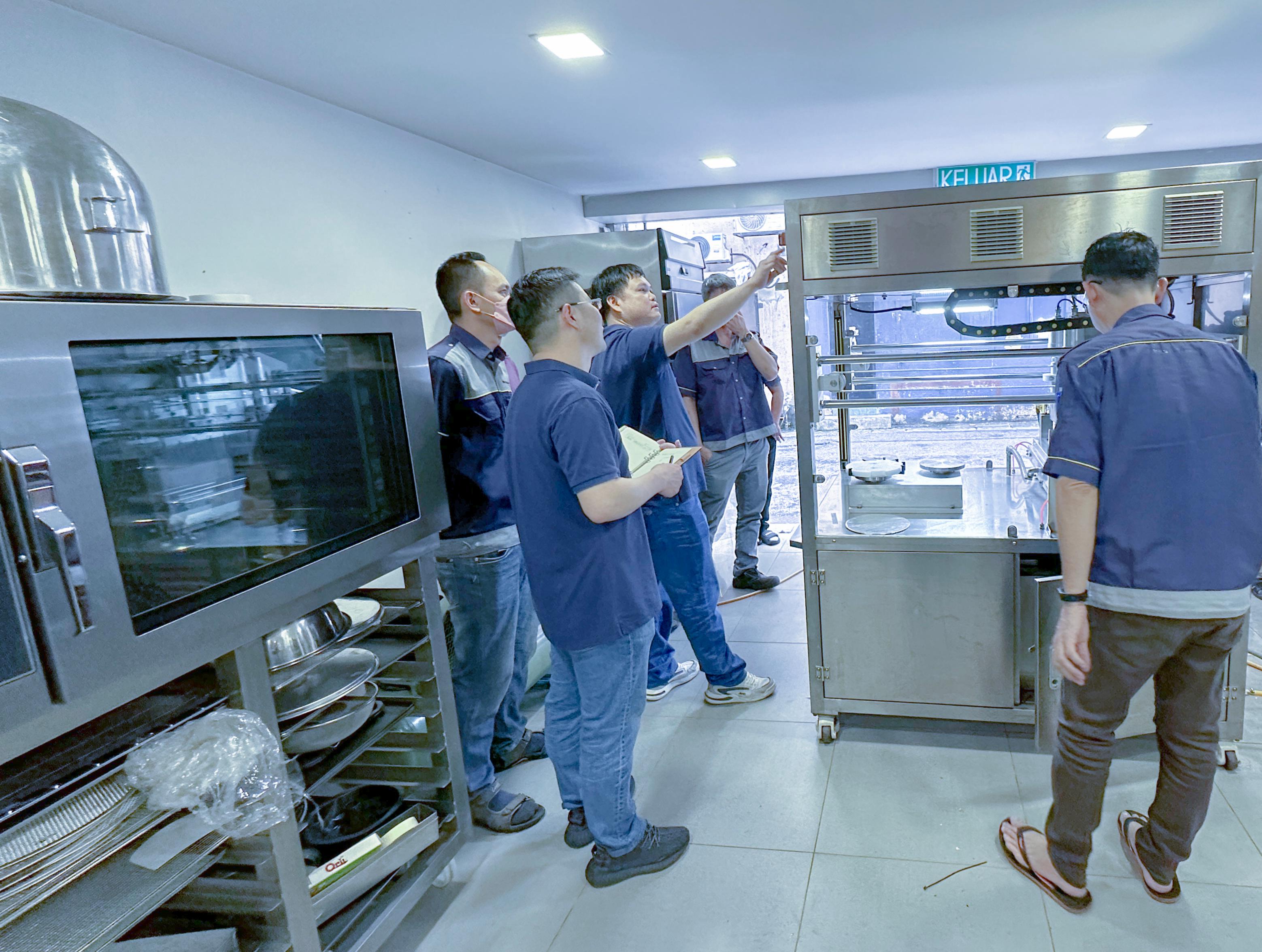
Every machine passes a 100% full running test before delivery. Request a sample cutting test on your product matrix to validate cut quality and portion accuracy.
Contact: Beaty Mao · Email: market2@cheersonic.com · Tel: +86 133-7254-0303 · WhatsApp: +86 158-6904-9660 · Address: No. 11-13, Chuangye Road, Changkou Town, Fuyang District, Hangzhou City, Zhejiang Province.
Have Questions or Need More Details?
Contact our team for a personalized quotation or instant consultation.
Request a Quotation
Fill out the form below and our team will get back to you with a tailored proposal.
WhatsApp Direct Chat
Prefer to chat in real-time? Message us on WhatsApp for instant assistance & quick answers.
- Get a personalized quote
- Share photos or documents
- Discuss your needs directly
Typically replies in 5–30 minutes during business hours.