
Regional Compliance for Ultrasonic Machines in Smart Manufacturing: IP65, Voltage & Frequency
Regional Compliance for Ultrasonic Machines in Smart Manufacturing: IP65, Voltage & Frequency
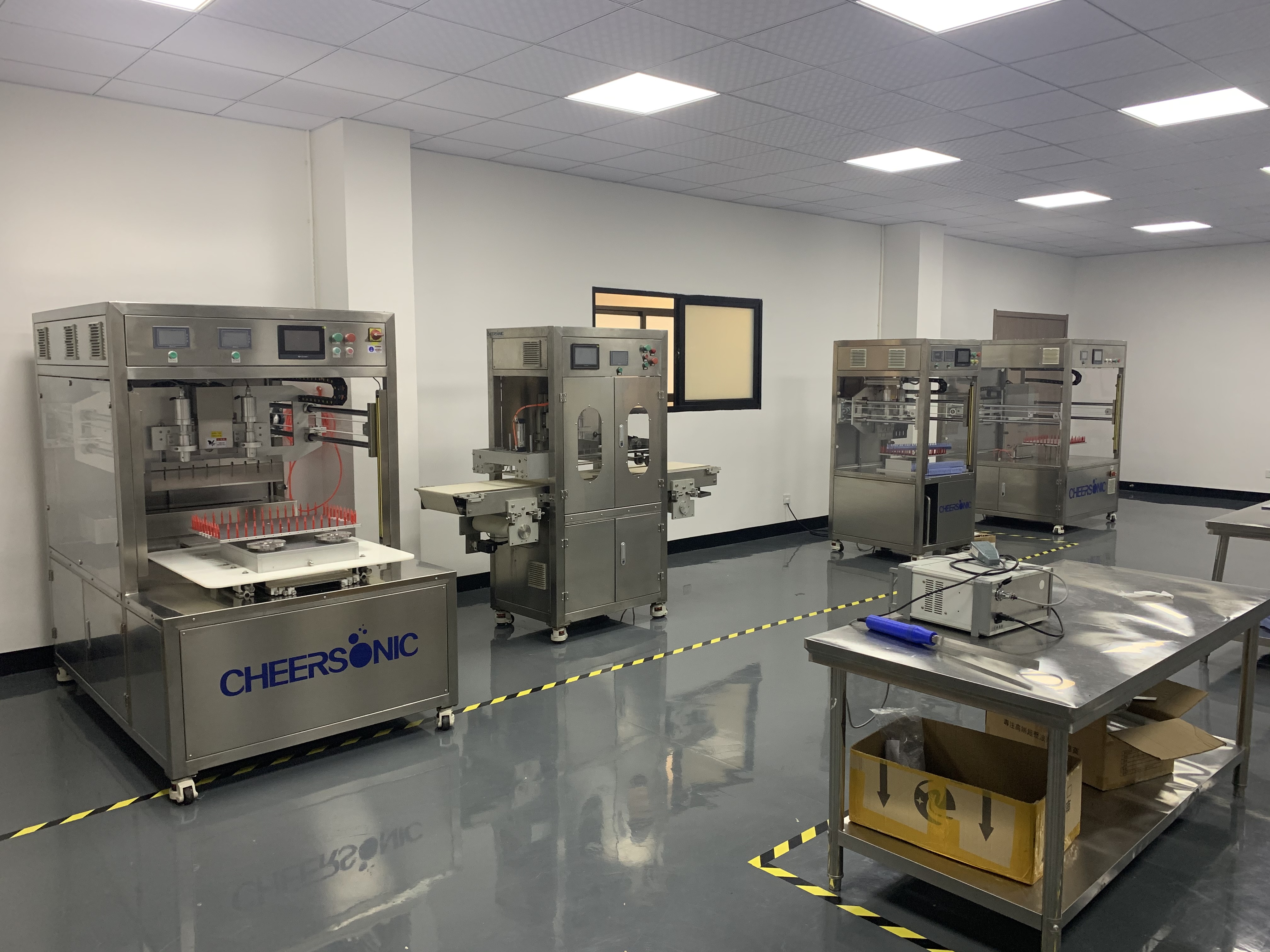
Cheersonic ultrasonic equipment sample workshop, Hangzhou: configurations are tested before shipment, which is where most unit-level compliance evidence is generated.
Regional compliance for an ultrasonic machine is decided at the unit level, not at the brand level. A machine specified at IP65, 208–240 V, 50/60 Hz, 15 A, with a 20–180 kHz operating frequency and stainless steel/titanium alloy construction can pass facility and safety review in most smart-manufacturing plants — but only when the shipped configuration, nameplate data, wiring and test records match what the reviewing engineer expects to see.
Cheersonic (HANGZHOU CHEERSONIC ULTRASONICS EQUIPMENTS CO.,LIMITED) is an ultrasonic equipment manufacturer founded in 2014 and based in Fuyang District, Hangzhou, China. The company builds ultrasonic cutting, slicing, coating and spray/atomization systems for baking, dairy, medical, electronics and energy applications, and exports to Asia, the EU and North America. Shipping into several regulatory environments is the reason this guide exists: the same platform arrives at sites that ask different questions during review.
This article maps the verified Cheersonic specification envelope to the checkpoints that appear in electrical, ingress-protection and material reviews, and it shows which documents to request so that approval does not depend on unverified certification claims.
Problem Definition: Where Regional Compliance Reviews Actually Break Down
Compliance problems on ultrasonic installations rarely start with a defective machine. They start with a gap between what was quoted, what arrived, and what the site must be able to demonstrate to its own electrical, safety or hygiene reviewers.
- Environment mismatch. IP65 means a dust-tight enclosure that also resists directed water jets, which suits washdown-adjacent zones in food plants and general industrial cells. It is not an immersion or high-pressure hose-down rating. When a hygiene reviewer expects full enclosure washdown, the machine will not pass no matter what the sales brochure claims.
- Electrical mismatch. A 208–240 V, 50/60 Hz, 15 A rating spans a broad band of industrial supplies, but phase configuration, available circuit capacity, protective grounding, disconnect and emergency-stop arrangement, and the local connection standard remain site facts. They are confirmed by survey, not by catalogue.
- Evidence mismatch. Statements such as “CE certified” or “FDA compliant” describe a company or a product family. Reviewers increasingly ask for nameplate data, a wiring diagram, a risk assessment and test records tied to the delivered unit and configuration. If those documents do not exist, the review stops.
- Application mismatch. Operating frequency is fixed by the transducer and the process. A frequency point chosen for food cutting is not the point used for fine atomization. Quoting the full 20–180 kHz range without stating where the delivered machine sits inside it leaves a documented gap.
Working rule for buyers: any compliance statement that cannot be tied to a model, a configuration and a serial number is marketing, not evidence. Request unit-level documents before the purchase order is released, not after the machine is on the floor.
Industry Background: Why Ultrasonic Equipment Sits Inside the Review
Ultrasonic processing has moved from standalone bench equipment into automated production cells. Cutting heads are mounted on robotic arms and inline conveyors; coating and atomization systems feed continuous coating lines; slicing units run at fixed output rates. Once integrated, ultrasonic equipment inherits the review standards of the whole line — electrical inspection, machinery risk assessment, hygiene zoning and documentation control.
Market data support the scale of that integration:
- The global ultrasonic spray systems market was valued at USD 0.5 billion in 2024 and is projected to reach USD 1.2 billion by 2034 (Ultrasonic Spray Systems Market Report 2024-2034, Market Research Future).
- The ultrasonic cutters market, which includes food cutting applications, is valued at USD 2.8 billion in 2025 with a projected CAGR of 7.2% through 2033 (Dataintelo).
- The medical device coatings market — a major downstream user of ultrasonic spray technology — is estimated at USD 16.27 billion in 2025, with anti-microbial coatings accounting for a 31.8% revenue share (Grand View Research).
- Asia Pacific represented approximately 25% to 38% of global ultrasonic technology and sensor revenue in 2025, depending on sub-segment (Fortune Business Insights).
Against that backdrop, Cheersonic operates a 7,150 m² factory in Hangzhou with around 100 employees, an annual output of roughly 1,200 units and a 20-engineer R&D team. Company information records 31 patents and 3 software copyrights, along with ISO9001, EU CE and US FDA certifications, registered capital of 10 million RMB, and an export ratio near 50% with main markets in Asia, the EU and North America. For a buyer, that export profile is context rather than proof: it means multi-market documentation questions are routine, and it gives a concrete question set to put to the supplier.
The Verified Specification Envelope: What IP65, 208–240 V / 50–60 Hz / 15 A and 20–180 kHz Cover
Cheersonic ultrasonic machines are specified with IP65 enclosure protection, a 208–240 V rated voltage, 50/60 Hz, 15 A, an operating frequency range of 20–180 kHz, and stainless steel/titanium alloy construction. Each item maps to a specific checkpoint in a regional review.
IP65: dust-tight and water-jet protected, not immersion rated
In an IP code the first digit describes solids protection and the second describes liquids protection. A rating of 6 for solids indicates a dust-tight enclosure; a rating of 5 for liquids indicates protection against directed water jets. Practically, that allows an ultrasonic machine to work beside washdown zones in baking, dairy and general processing areas without internal water ingress during normal cleaning. It does not permit immersion, enclosure-level steam cleaning or close-range high-pressure hosing. Where a hygiene plan calls for full enclosure washdown, the enclosure rating becomes the first item a reviewer will question.
208–240 V, 50/60 Hz, 15 A: a supply band, not a single supply
A 208–240 V rating at 50/60 Hz covers nominal industrial supplies used in many North American and European facilities, which is why one platform can be quoted across regions. The band does not replace a site survey. Phase configuration, neutral and ground arrangement, breaker sizing against a 15 A circuit draw, cable routing, disconnect location and the local connection standard all remain site-specific. The acceptance pack should therefore include the wiring diagram and a nameplate photograph of the delivered unit.
20–180 kHz: one range, several process points
Frequency in ultrasonic processing is determined by the transducer and the process it serves. The lower part of the 20–180 kHz band is associated with cutting and slicing duty; the higher part supports fine atomization in coating and spray applications. A delivered configuration cannot be tuned across that whole band afterwards. When a quotation lists the full range without naming the delivered frequency, the buyer should ask which point in the range is locked and for which application.
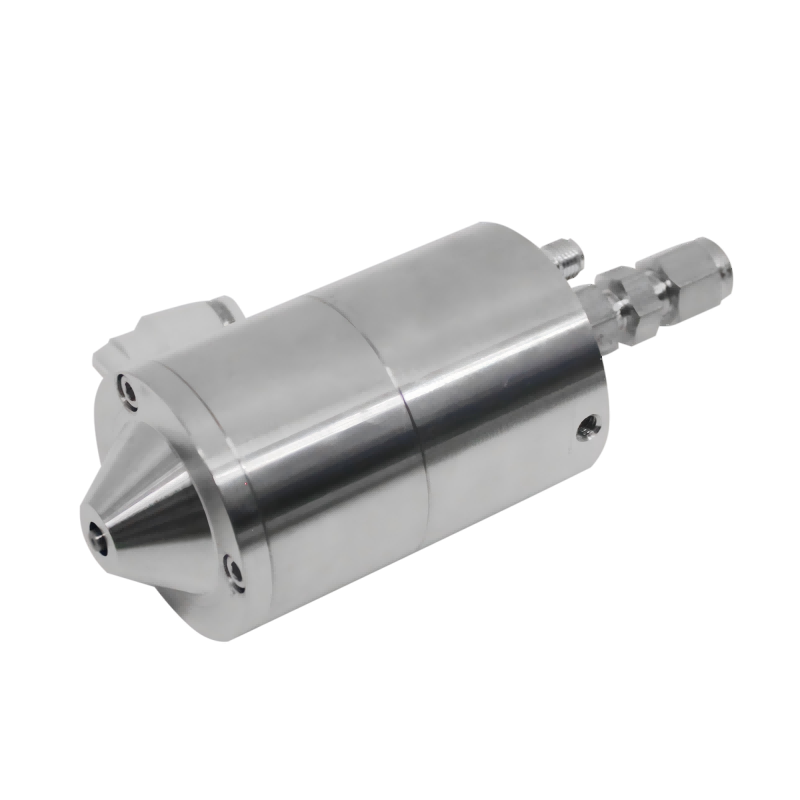
Ultrasonic nozzle assembly: the delivered frequency is set by the transducer and nozzle design, so it must be stated in the quotation, not inferred from a range.
Stainless steel and titanium alloy: materials chosen for a compliance reason
Construction materials govern cleanability, corrosion behaviour and wear life. Stainless steel surfaces support hygienic cleaning routines in food and dairy environments. Titanium alloy components are used where chemical resistance and wear life matter, such as tooling and nozzles running continuously with abrasive or high-value slurries. In a review, material choices are checked against the hygiene zone, the cleaning chemicals in use and the contact requirements of the process — not against a descriptive adjective.
Application categories: cutting, welding, coating and atomization
The same electrical and enclosure logic applies across ultrasonic application categories, but the review emphasis shifts. Cutting and slicing draw hygiene and operator-safety attention. Coating and atomization draw uniformity, chemical-handling and exhaust attention. Ultrasonic welding, where it forms part of a production line, draws process-validation attention. Cheersonic’s documented lines cover ultrasonic cutting and slicing equipment (ultrasonic cutting machines, ultrasonic slicing machines, ultrasonic food cutting machines, ultrasonic cake cutting machines, ultrasonic cheese cutting machines) and coating and atomization systems (ultrasonic nozzle, ultrasonic coating, ultrasonic spray, catalyst deposition machine, fuel cell coating system, spray pyrolysis system, ultrasonic stent coating machine, balloon coating machine, ultrasonic spray fluxing and photoresist coating systems).
| Verified specification | What it tells the review team | What to request from the supplier |
|---|---|---|
| IP65 enclosure protection | Dust-tight and protected against directed water jets; suitable beside washdown zones, not for immersion or high-pressure hose-down | Enclosure rating statement tied to model and serial number; cleaning instructions and stated limits |
| 208–240 V rated voltage, 50/60 Hz, 15 A | Matches common industrial supply bands used in North America and Europe, allowing one platform across regions | Nameplate photograph, wiring diagram, breaker and grounding requirements, disconnect arrangement |
| 20–180 kHz operating frequency | Covers cutting and slicing duty at the lower points and fine atomization at higher points | The delivered frequency point, stated in the quotation and matched to the application |
| Stainless steel / titanium alloy construction | Cleanability, corrosion and wear behaviour relevant to hygiene zones and chemical exposure | Material statement for contact and tooling parts; cleaning chemical compatibility guidance |
| Application category (cutting, welding, coating, atomization) | Determines which review route applies: hygiene zoning, chemical handling or process validation | Process data for the intended material, trial or sample results, defined acceptance criteria |
Step-by-Step: Preparing a Regional Compliance File for an Ultrasonic Machine
The sequence below follows the order in which facility, electrical and safety reviewers typically raise questions. Running it before purchase order release prevents most rework.
Step 1 — Classify the installation environment
Decide whether the machine sits in a dry cell, a washdown-adjacent zone, a refrigerated area or a controlled cleanroom. That decision sets the enclosure expectation (IP65 or a higher rating), the cleaning method and whether the frame must resist particular chemicals.
Step 2 — Confirm the site electrical facts
Record nominal voltage, phase configuration, frequency, available circuit capacity, grounding arrangement and disconnect location. Compare them with the 208–240 V, 50/60 Hz, 15 A rating and identify any transformer, connector or protection change needed.
Step 3 — Lock the delivered operating frequency to the application
State the process first — cutting, slicing, coating or atomization — and require the quotation to name the delivered frequency inside the 20–180 kHz range.
Step 4 — Confirm materials and cleaning chemistry
Verify stainless steel and titanium alloy use in the parts that contact product, then cross-check those materials against the cleaning agents in use. Chemical compatibility questions belong in the review file, not in a post-installation email.
Step 5 — Assemble the unit-level document pack
Request nameplate data, wiring diagram, enclosure rating statement, material statement, cleaning instructions and a spare-part list for the specific configuration and serial number being shipped.
Step 6 — Align the risk assessment with ISO 12100:2010
ISO 12100:2010 sets out the general framework for machinery risk assessment and risk reduction. Its logic — identify hazards, estimate risk, reduce risk by design, then by safeguarding, then by information for use — maps directly onto the controls used on ultrasonic equipment: a stable, firmly mounted machine with sufficient working space; grounded power cords; an emergency stop that cuts power immediately in an abnormal situation; an overload protection mechanism; parameters such as power, amplitude and speed set to the material rather than to the maximum; close monitoring of operating status during processing; protective goggles and safety gloves, plus noise protection during long operating sessions; documented operating procedures covering before, during and after use; operator training on equipment principles and procedures; and scheduled maintenance including surface residue cleaning after each use, transmission tension checks, lubrication, replacement of worn parts and dry, clean storage when the machine is idle for long periods.
Step 7 — Define acceptance testing and pre-shipment evidence
Cheersonic’s acceptance approach is a full performance test at the factory before shipment, with video and test reports supplied for customer confirmation ahead of dispatch. That evidence is what a reviewer can file; a general statement about quality is not.
Step 8 — Settle commercial and delivery terms, then plan the installation window
Cheersonic quotes a minimum order quantity of 1 unit, arranges delivery under FOB, CIF or DDP incoterms, and works on a 30% T/T advance deposit upon order confirmation with a 70% balance T/T against the copy of the bill of lading. Once those terms are fixed, schedule the electrical survey, rigging and operator training so the compliance file closes at commissioning rather than months later.
Coating and atomization configurations are validated in the laboratory before delivery, which supports the process data a review file needs.
Use Cases: Which Compliance Items Each Application Triggers
Bakery and dairy cutting lines
Ultrasonic food cutting machines portion cheesecake, layer cake, bread, butter, cheese, pizza and sandwich products without the deformation caused by mechanical blades. Cheersonic’s ultrasonic slicing models support production rates of 80 to 1,500 cakes or pies per hour in both inline and offline layouts. Compliance attention here falls on hygiene zoning, IP65 cleaning practice, blade handling and operator safety — and on the fact that no wastewater treatment or smoke extraction is required as a secondary process.
Medical device coating
Stent, balloon and blood-collection-tube coating depends on uniform thin films over small, sometimes irregular surfaces. The relevant evidence is coating thickness consistency and material utilisation: ultrasonic spray delivers material utilisation of roughly 88% to 92% with thickness deviation near ±3%, compared with about 35% to 40% utilisation and ±22% deviation for dip coating. In a review, that difference becomes a process-capability and material-control document, not just an equipment specification.
Electronics and functional films
Photoresist coating systems and nano-functional film deposition for touch screens and circuit boards raise questions about chemical handling, ventilation and coating repeatability. Buyers commonly request process data at the wafer or panel level alongside the electrical documentation.
Energy and catalyst layers
Fuel cell coating systems, catalyst deposition machines and spray pyrolysis systems work on proton exchange membranes, catalyst layers and solar cell coatings. Because these processes run at ambient temperature and atmospheric pressure, the review focuses on coating uniformity, material utilisation and line integration instead of vacuum or high-temperature process safety.
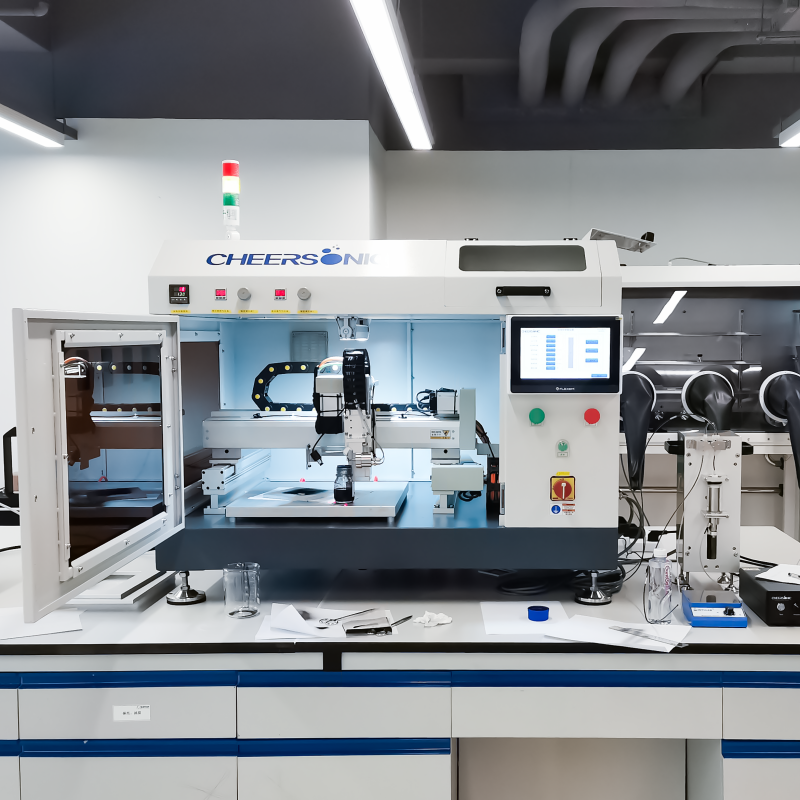
Ultrasonic coating operates at ambient temperature and atmospheric pressure, which changes which safety and utility items a facility review has to cover.
Comparison: Ultrasonic Cutting and Coating Against Conventional Alternatives
The two tables below summarise performance and process differences recorded for Cheersonic ultrasonic systems against the conventional methods they most often replace. They are included because compliance files usually need a justification section as well as a specification section.
| Method | Cutting principle | Recorded loss / yield effect | Maintenance profile | Typical fit |
|---|---|---|---|---|
| Ultrasonic cutting (Cheersonic) | High-frequency ultrasonic separation; low-temperature dry cut | Material loss controlled within 2%; yield improved 15%–30% versus traditional methods | Blade replaced every few months; no fume or wastewater treatment | Soft, sticky, layered, brittle and multi-layer foods |
| Traditional stainless steel knife | Physical extrusion cutting | Loss of 8%–18% | Daily polishing, frequent blade changes, shutdowns to clear sticky material | Firm, simple products |
| Wire cutter | Mechanical wire separation | Loss of 8%–18%, reduced to within 2% when replaced by ultrasonic cutting | Wire replaced every 1–3 days; stretching and deformation affect the cut | Elastic and multi-layer products, with higher downtime |
| Water cutting | High-pressure water impact | Loss of 8%–18%, plus drying and wastewater handling | Nozzle clogging, daily cleaning, wastewater hygiene management | Water-tolerant materials only |
| Laser cutting | High-temperature melting | Loss of 8%–18%; carbonisation and fume generation | Monthly lens and consumable replacement; extraction equipment | Non-food industrial materials |
| Review metric | Ultrasonic spray (Cheersonic) | Dip coating | CVD | Sputtering (PVD) |
|---|---|---|---|---|
| Material utilisation | About 88%–92% for coating systems; over 95% in spray applications | About 35%–40% | Material consumed in gas-phase reaction | Target material consumed during deposition |
| Coating thickness deviation | About ±3% | About ±22%, with edge build-up | Not comparable to atmospheric spray data | Not comparable to atmospheric spray data |
| Equipment scale-up | Baseline | Immersion tanks and long drying cycles | Expansion cost over 90% higher than ultrasonic; daily water and power use over 85% higher | Investment cost over 80% higher than ultrasonic; continuous throughput 3–10 times lower |
| Operating environment | Ambient temperature, atmospheric pressure, inline | Immersion and drying | High temperature with vacuum | Vacuum chamber, batch processing |
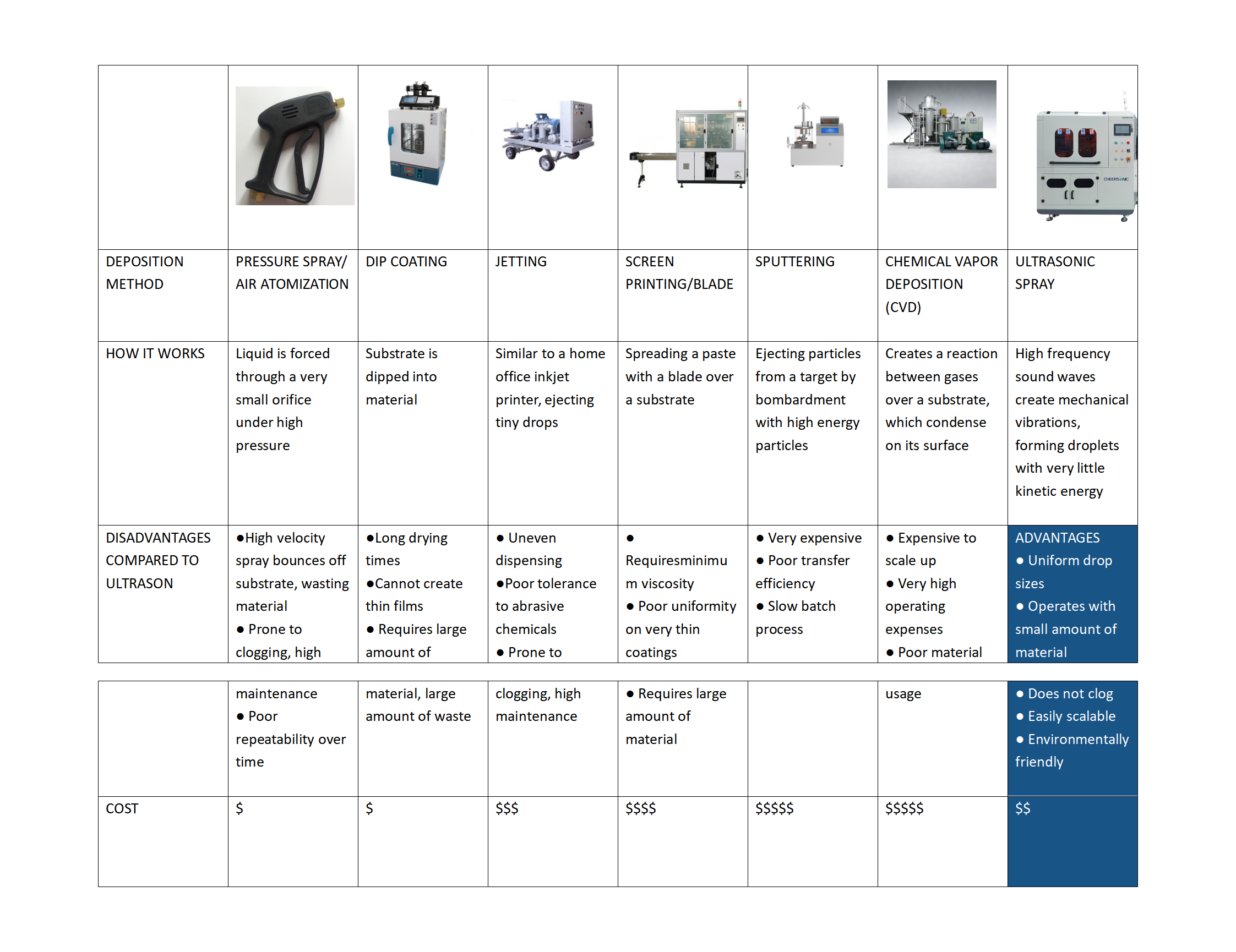
Recorded comparison data for ultrasonic thin-film coating against alternative coating processes, as supplied in Cheersonic product documentation.
FAQ: Compliance, Capability, Cost, Sampling and Long-Term Supply
1. What documentation should we request to confirm IP65, voltage and frequency compliance for a specific ultrasonic machine?
Request five items for the exact configuration and serial number being shipped: (1) nameplate data showing IP65 enclosure protection, the 208–240 V rated voltage, and the 50/60 Hz, 15 A rating; (2) the delivered operating frequency, stated as a point inside the 20–180 kHz range and matched to the application; (3) the wiring diagram, grounding arrangement and circuit requirements; (4) a material statement confirming stainless steel and titanium alloy construction for the relevant parts; and (5) a machinery risk assessment prepared along the lines of ISO 12100:2010. Company-level certification statements, such as the ISO9001, EU CE and US FDA certifications held by Cheersonic, are useful background, but they should be filed alongside — not instead of — the unit-level documents that show what was actually shipped.
2. Can one ultrasonic platform cover cutting, coating and atomization requirements?
Not as a single configuration. Cheersonic builds separate equipment families: ultrasonic cutting and slicing machines for food, cake and cheese processing, and coating and atomization systems such as the ultrasonic nozzle, ultrasonic coating and ultrasonic spray units, catalyst deposition machines, fuel cell coating systems, spray pyrolysis systems, stent and balloon coating machines, spray fluxing units and photoresist coating systems. The shared 20–180 kHz operating band describes the technology range, not one adjustable machine. Buyers should specify the application first, then require the delivered frequency and tooling to be confirmed for that application.
3. What drives the long-term cost of an ultrasonic machine beyond the purchase price?
Four factors dominate. First, material yield: ultrasonic cutting controls material loss within 2% while traditional cutting methods typically lose 8% to 18%, and ultrasonic spray reaches roughly 88% to 92% material utilisation against about 35% to 40% for dip coating. Second, auxiliary equipment: ultrasonic cutting removes the need for smoke extraction, wastewater treatment and drying steps, and ultrasonic coating runs at ambient temperature and atmospheric pressure instead of requiring vacuum or high-temperature systems — equipment scale-up cost is recorded as over 90% lower than CVD and investment cost over 80% lower than sputtering, with daily water and power consumption cut by more than 85% versus CVD. Third, consumables: no screen, blade or target-material replacement is required in coating processes, and ultrasonic cutting blades are typically replaced every few months rather than daily. Fourth, maintenance labour: nozzles designed for particle-containing slurries reduce blockage-related downtime. Cheersonic quotes per configuration, so machine price depends on the specified frequency, tooling, materials and integration level.
4. What is the minimum order quantity, and how is the machine accepted before shipment?
The minimum order quantity is 1 unit, and delivery is arranged under FOB, CIF or DDP incoterms. Acceptance is based on a full performance test carried out at the Cheersonic factory before shipment, with video and test reports provided for customer confirmation ahead of dispatch. Payment terms are a 30% T/T advance deposit upon order confirmation and a 70% balance T/T against the copy of the bill of lading.
5. How do buyers structure a long-term ultrasonic machine supply relationship with a partner in China?
Start with documentation rather than price. A long-term relationship works when the supplier can repeat the same unit-level evidence on every shipment: configuration sheets, nameplate data, wiring diagrams, test reports and material statements. Cheersonic exports around 50% of its output to Asia, the EU and North America, holds ISO9001, EU CE and US FDA certifications according to company information, and supports customers from equipment customisation through to technical support, with delivery under FOB, CIF or DDP terms and standard 30/70 T/T payment. Buyers preparing a multi-year programme can begin with a single-unit trial: request a configuration quotation, a sample or trial evaluation and the current product brochure at www.cheersonic.com, then use the first unit’s documentation pack as the template for every later order.
Conclusion: Compliance Is a Document Trail, Not a Badge
For ultrasonic machines in smart manufacturing, regional compliance is assembled from specific, verifiable items: IP65 enclosure protection that matches the cleaning method, a 208–240 V / 50–60 Hz / 15 A supply rating that matches the site, a delivered operating frequency inside the 20–180 kHz band that matches the process, and stainless steel/titanium alloy construction that matches the hygiene and chemical environment. Each one can be confirmed with a nameplate, a drawing, a test report or a material statement.
The practical advantage of this approach is that it removes dependence on unverified certification claims. A buyer who requests unit-level documents before purchase order release can file the same evidence with an electrical reviewer, a hygiene reviewer and a safety reviewer — and can repeat the process on every future shipment.
Next Step: Build Your Compliance File From a Unit-Level Quotation
If you are preparing a compliance file for an ultrasonic machine in a smart-manufacturing project, start with the items your review team will ask about first: enclosure rating, supply voltage and frequency, circuit draw, delivered operating frequency and contact materials. Cheersonic can supply configuration data, pre-shipment performance test video and reports, and documentation support for the delivered unit.
Contact: Beaty Mao | Email: market2@cheersonic.com | Tel: +86 133-7254-0303 | WhatsApp: +86 158-6904-9660 | Address: No. 11-13, Chuangye Road, Changkou Town, Fuyang District, Hangzhou City, Zhejiang Province, China | Website: www.cheersonic.com
Download the full product brochure: CHEERSONIC brochure (PDF). Sample requests and quotations are handled per configuration; minimum order quantity is 1 unit.
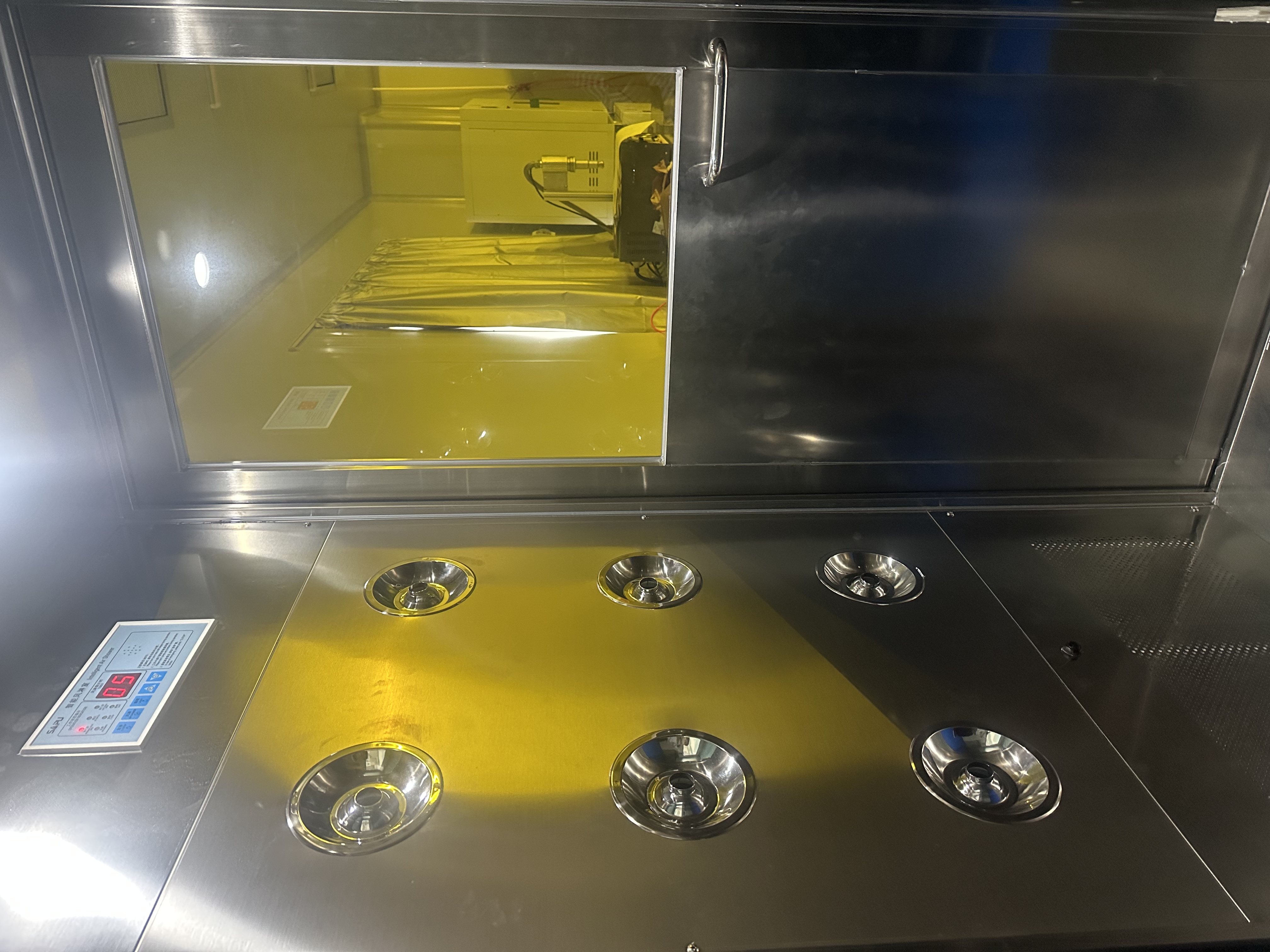
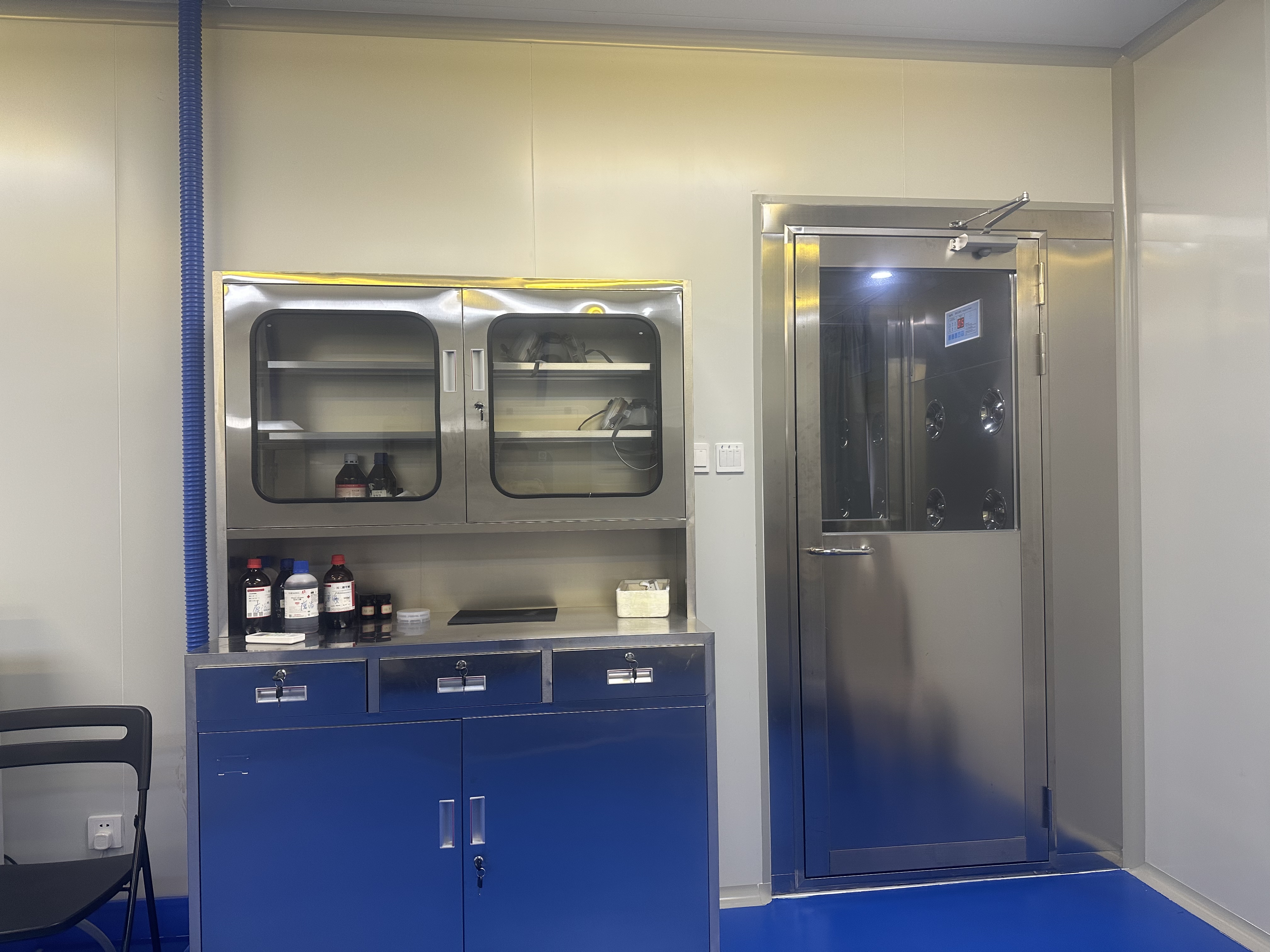
Sample and configuration evaluation support in the Cheersonic laboratory — the starting point for a documented, comparison-ready procurement.
Have Questions or Need More Details?
Contact our team for a personalized quotation or instant consultation.
Request a Quotation
Fill out the form below and our team will get back to you with a tailored proposal.
WhatsApp Direct Chat
Prefer to chat in real-time? Message us on WhatsApp for instant assistance & quick answers.
- Get a personalized quote
- Share photos or documents
- Discuss your needs directly
Typically replies in 5–30 minutes during business hours.