
Which Ultrasonic Machine Should You Buy? Cutting vs. Coating Cost-Performance Guide
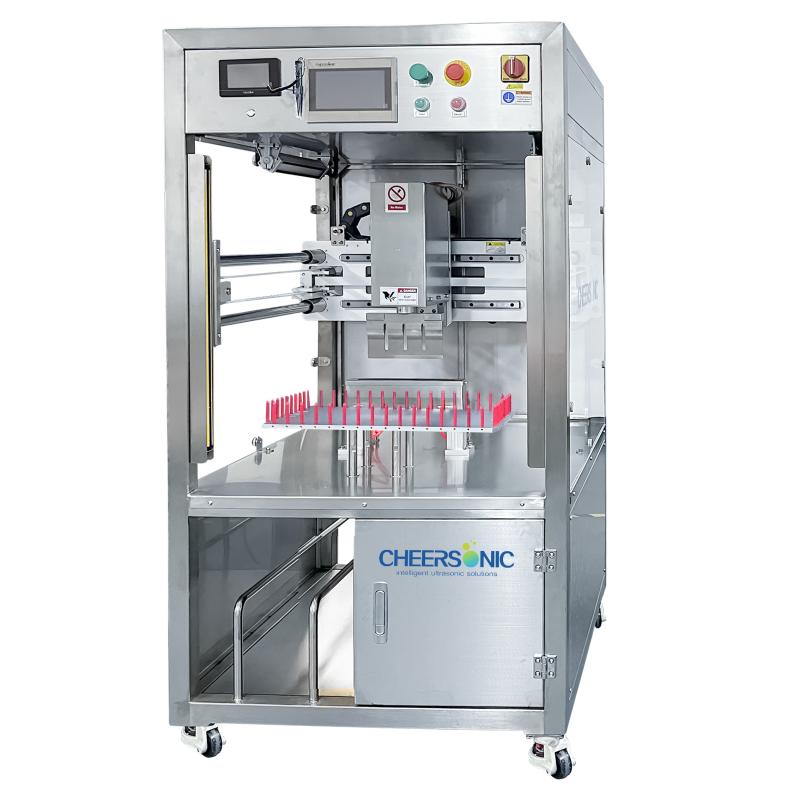
Ultrasonic machines use high-frequency acoustic vibration to cut, slice, or atomize materials without the high temperatures, high pressures, or physical contact forces used by many conventional industrial processes. In food production, ultrasonic cutting separates soft, sticky, or layered products with a clean cut surface. In precision manufacturing, ultrasonic spray coating deposits thin, uniform liquid films onto surfaces that may be fragile, temperature-sensitive, or geometrically complex.
This guide compares the two main categories of ultrasonic machines—ultrasonic cutting and slicing equipment, and ultrasonic spray coating systems—against the traditional processes they replace: laser cutting, water jet cutting, wire cutting, stainless steel blade cutting, chemical vapor deposition (CVD), sputtering, jetting, dip coating, and pressure spraying. It also explains how to evaluate an ultrasonic machine manufacturer before purchase. Product and company data refer to Cheersonic (Hangzhou Cheersonic Ultrasonics Equipment Co., Limited), a manufacturer of ultrasonic cutting, slicing, and coating systems based in Fuyang District, Hangzhou.
Why Ultrasonic Machine Selection Is Difficult
Most purchasing mistakes in ultrasonic equipment come from comparing machine specifications too early and process behavior too late. A cutting machine's real performance shows in deformation, sticking, and scrap over weeks of continuous production. A coating machine's real performance shows in material utilization, thickness consistency, and nozzle reliability over hundreds of operating hours.
Buyers also face a second difficulty: the term "ultrasonic machine" covers very different equipment. Ultrasonic cake cutting machines, ultrasonic cheese cutting machines, and ultrasonic food cutting machines solve adhesion and deformation problems in food. Ultrasonic spray coating systems solve uniformity and waste problems in medical, electronics, and energy applications. The correct first step is to separate the application question from the supplier question.
Ultrasonic Technology in Context: Market and Industry Background
Ultrasonic equipment operates in two large industrial segments, and third-party market data helps put the investment in context. The global ultrasonic spray systems market was valued at USD 0.5 billion in 2024 and is projected to reach USD 1.2 billion by 2034. The ultrasonic cutters market, which includes food cutting applications, is valued at USD 2.8 billion in 2025 and is projected to grow at a CAGR of 7.2% through 2033. In the medical sector, the medical device coatings market is estimated at USD 16.27 billion in 2025, with anti-microbial coatings representing a 31.8% revenue share. Asia Pacific accounted for approximately 25% to 38% of global revenue across different ultrasonic sub-segments in 2025.
In the supplier landscape, industry reports (Cognitive Market Research / Coatings World, 2024) list Sono-Tek Corporation, Branson (Emerson), Dukane, and Cheersonic among key global players in the ultrasonic equipment and spray coating sector. That list is useful context, but the right manufacturer still depends on the specific cutting or coating task.
Ultrasonic Cutting vs. Traditional Cutting Equipment
Cheersonic manufactures ultrasonic cutting, ultrasonic slicing, ultrasonic food cutting, ultrasonic cake cutting, and ultrasonic cheese cutting machines for bakeries, dairies, and producers of candy and pet food. The range includes small standalone machines for manual facilities and large inline robotic solutions for high-speed production. Ultrasonic slicing models support production speeds of 80 to 1,500 cakes or pies per hour, and offline models can include divider inserts between slices to improve cut quality and product presentation.
The UFM6000 Multi-functional Ultrasonic Cutter is a representative example. It uses high-frequency ultrasonic cutting for low-temperature, dry-type, vibration separation cutting, avoiding the extrusion, stretching, high-pressure impact, and high-temperature burning found in conventional methods.
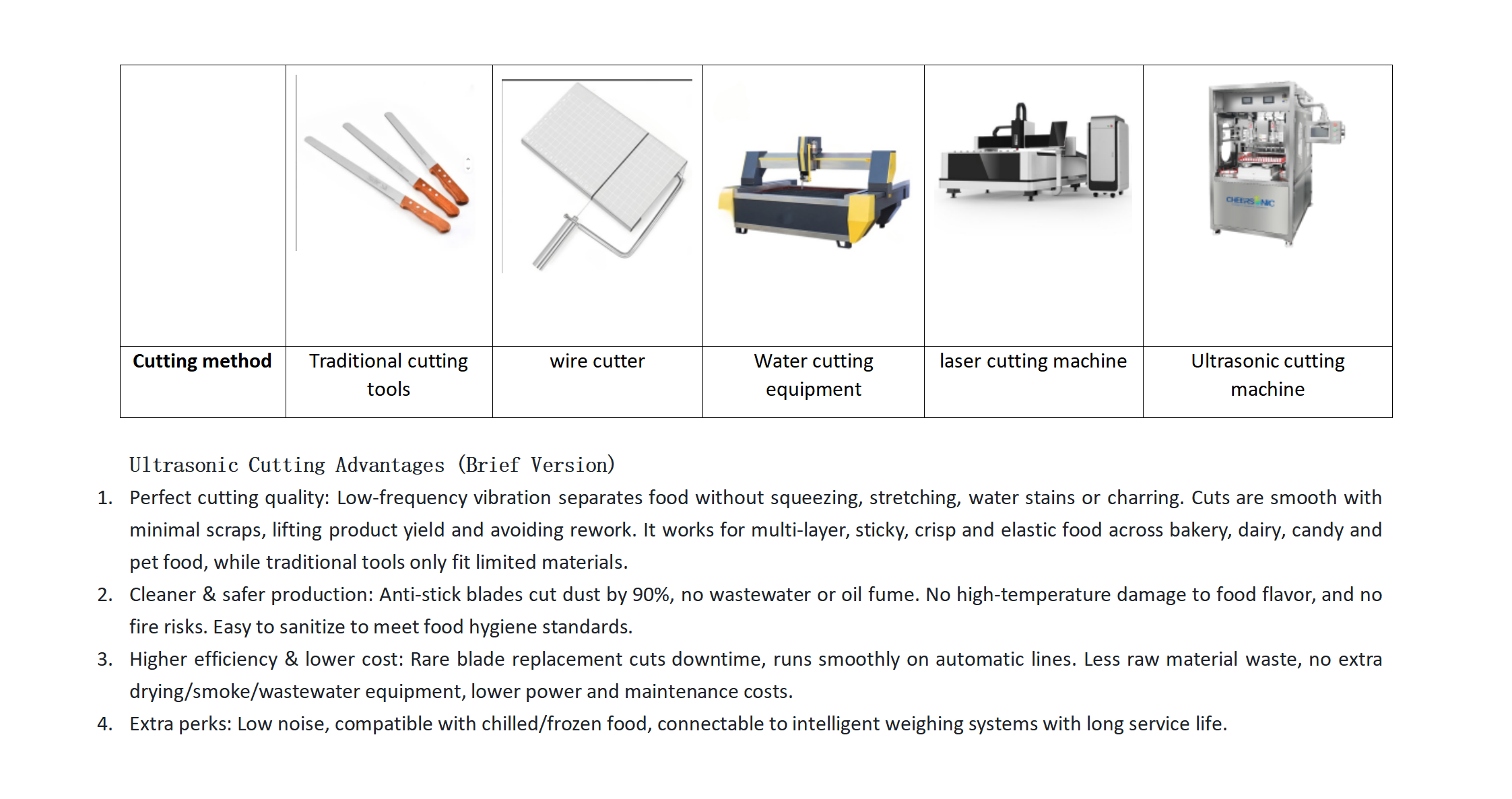
| Factor | Ultrasonic cutting | Laser cutting | Water cutting | Wire cutting | Stainless steel knife |
|---|---|---|---|---|---|
| Process principle | High-frequency vibration separation; low-temperature, dry-type cutting | High-temperature melting and burning | High-pressure water flow impact | Tension-based mechanical separation | Physical extrusion cutting |
| Temperature and product effect | Contact surface temperature rise below 40 °C; no burning or carbonization | Risk of food coking, carbonization, and oil fume | Moisture damage, water stains, and material dilution | Stretching, deformation, delamination, and tearing | Extrusion deformation, sticking, and debris |
| Yield and material loss | Yield +15% to 30%; loss rate within 2% | Loss rate 8%–18% | Loss rate 8%–18% | Loss rate 8%–18% | Loss rate 8%–18% |
| Maintenance and consumables | Blade replaced every few months; simple cleaning | Lens oil fume pollution; monthly consumable replacement | Nozzle clogging; daily cleaning; wastewater treatment | Wire replaced every 1–3 days | Daily polishing; weekly blade replacement |
| Best-fit materials | Baking, dairy, candy, pet food; soft/hard, high-viscosity, multi-layer, porous, puffed; room-temperature, refrigerated, and semi-frozen | Not suitable for cream, chocolate, gelatinous dairy, and sugary powder ingredients | Not suitable for water-sensitive products such as fluffy cakes, puffed pet food, high-moisture mousse, and gel dairy | Suitable for high-elasticity, high-viscosity, multi-layer sandwich foods, but with quality limitations | Prone to deformation, collapse, and sticking on soft, porous, high-viscosity, and crispy materials |
Across the four traditional cutting methods above, material loss typically runs between 8% and 18%. Ultrasonic cutting controls the loss rate within 2% and increases finished product yield by 15% to 30%. Workshop dust is reduced by 90%, and blade continuous cutting time is dozens of times longer, which eliminates frequent shutdowns for cleaning and reduces downtime.
Ultrasonic Spray Coating vs. Traditional Coating Processes
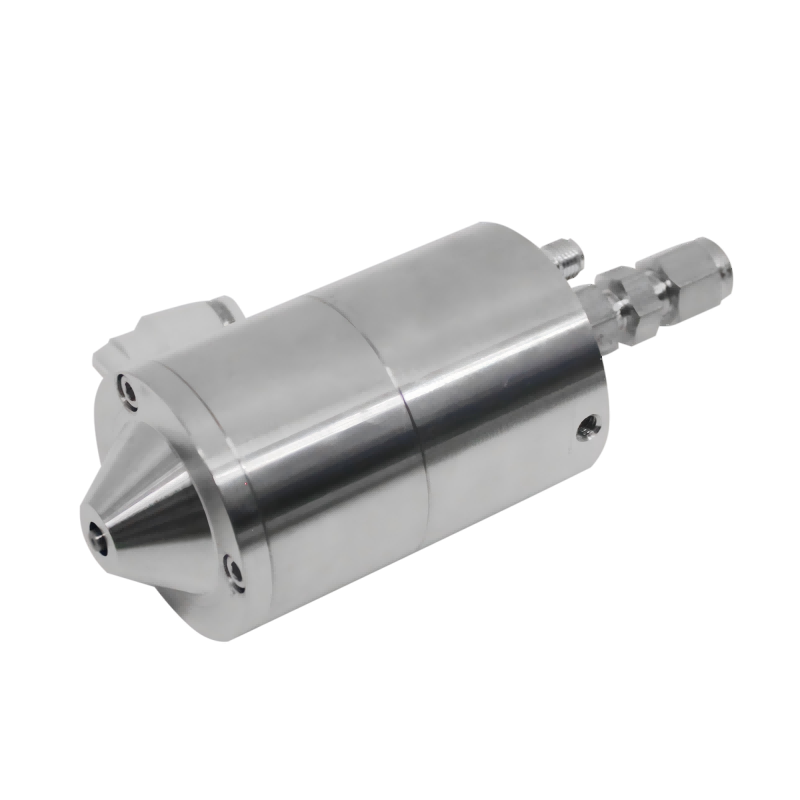
Cheersonic ultrasonic spray coating systems apply precise thin-film coatings in microelectronics, electronics, alternative energy, medical, and industrial markets, including specialized glass applications in construction and automotive. The company's ultrasonic spraying equipment is characterized by uniform coating, raw material utilization over 95%, and non-clogging nozzles. The technology atomizes liquids by high-frequency acoustic vibration and operates at ambient temperature and atmospheric pressure, which makes it suitable for substrates that cannot tolerate vacuum or high-temperature reaction environments.
| Factor | Ultrasonic spraying | CVD | Sputtering | Jetting | Dip coating |
|---|---|---|---|---|---|
| Operating conditions | Ambient temperature and pressure; non-contact acoustic atomization | High-temperature vacuum gas-phase reaction | High-energy ion bombardment in vacuum | High-pressure fluid injection | Full workpiece immersion and pull-up film formation |
| Material utilization | 88%–92% vs. dip coating; over 95% reported on Cheersonic equipment | Significant raw material loss in gas-phase reaction | Low transfer efficiency; target material waste | Higher consumable loss; ultrasonic reduces coating consumable loss by over 70% vs. jetting | 35%–40% |
| Coating uniformity and thickness | Thickness deviation ±3%; supports ultra-thin films from 50 nm to 5 μm; no edge buildup | Batch-based process; rhythm limited by vacuum and heating cycles | Uniform within chamber batch; limited by chamber size | Airflow interference; less concentrated droplet distribution | Thickness deviation ±22%; edge thick accumulation |
| Maintenance | Simple regular nozzle cleaning; anti-blocking; few wearing parts | High-temperature furnace, vacuum pump, and gas pipeline checks | Vacuum sealing inspection, chamber cleaning, and pump maintenance | Nozzle wear and blockage; frequent accessory replacement | Long drying cycles; process maintenance from edge defects |
| Best fit | Semiconductor wafers, medical stents, fuel cell catalyst layers, precious metal pastes, 3D curved surfaces | Substrates that tolerate high-temperature vacuum reaction | Smaller parts suited to vacuum chamber batch limits | General spraying of low-viscosity fluids; less suited to abrasive slurries and high-precision work | Simple geometries with high material consumption |
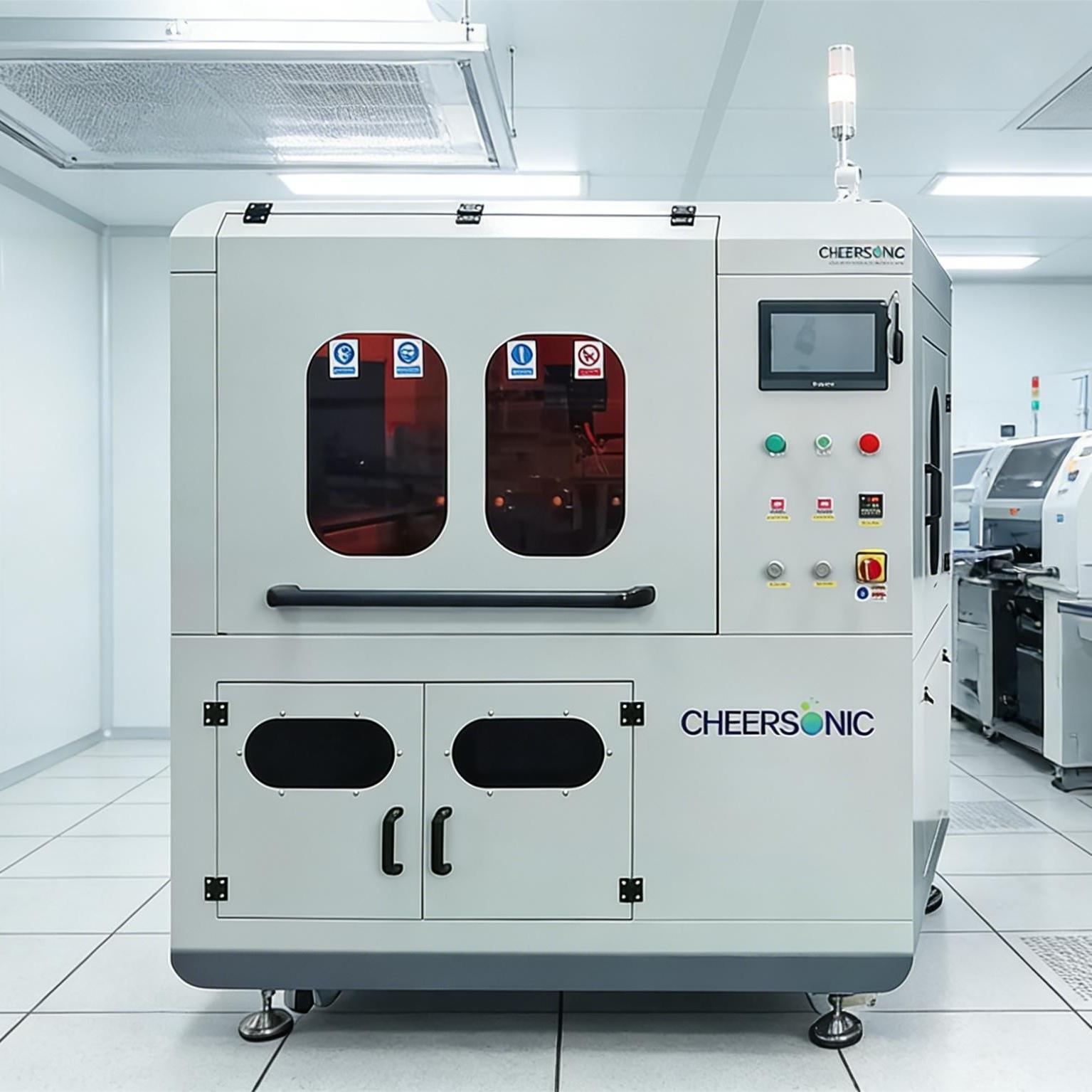
The economic difference shows up in two places: raw material and infrastructure. In the dip coating comparison, material utilization rises from 35%–40% to 88%–92%, and per-part liquid consumption drops from 1.2 mL to 0.35 mL. Against CVD, equipment capacity expansion cost falls by over 90%, and daily water and power consumption fall by more than 85%. Against sputtering, equipment investment is reduced by over 80%, with 70% lower running electricity and maintenance cost. These figures matter most when the coating liquid is expensive or the production line runs continuously.
Step-by-Step: How to Compare Ultrasonic Machines
- Define the application and the material set. Ultrasonic cutting suits baking, dairy, candy, and pet food, including soft, hard, high-viscosity, multi-layer sandwich, porous, and puffed materials at room temperature, refrigerated, or semi-frozen conditions. Ultrasonic spray coating suits high-precision, high-value coating tasks such as semiconductor wafers, medical stents, and precious metal pastes.
- Select the machine category before comparing models. If the task is portioning cakes, pies, loaves, butter, or cheese, evaluate ultrasonic cutting and slicing machines. If the task is applying functional films to a medical device, electronic component, or energy component, evaluate ultrasonic spray coating systems.
- Compare the process against the incumbent method with measured indicators. Use finished product yield, material loss rate, coating uniformity, and maintenance frequency. The tables in this guide provide reference points based on documented comparisons.
- Model the total cost, not the purchase price. Include supporting infrastructure, energy consumption, consumable replacement, and scrap. Ultrasonic cutting eliminates the need for smoke exhaust and wastewater treatment equipment; ultrasonic spraying avoids furnace, vacuum pump, and gas pipeline infrastructure.
- Verify compliance and safety. For general machinery safety, ISO 12100:2010 provides a framework for risk assessment and risk reduction. For export-oriented buyers, check that the supplier documents ISO 9001, EU CE, and US FDA compliance where relevant.
- Audit the manufacturer. Evaluate R&D depth, patents, factory capacity, export experience, and application-specific know-how. Request documentation, a sample test, or a technical consultation before committing.
Application Scenarios: Where Each Ultrasonic Machine Type Wins
Baking and Dairy
Cheersonic ultrasonic cake cutting machines and ultrasonic cheese cutting machines cut mousse cakes, cheesecakes, bread, cheese, and butter. The non-stick, low-temperature cutting surface avoids deformation and residue, and the equipment supports both manual bakeries and automated lines. Ultrasonic slicing machines handle 80 to 1,500 cakes or pies per hour, which makes the technology practical for start-up bakeries and high-production commercial facilities alike.
Medical Device Coating
In the medical field, Cheersonic spray coating systems produce functional coatings for devices such as stents, balloons, and blood collection tubes, supporting biocompatibility and precision. Ultrasonic spraying's thickness control and uniformity are relevant for high-value thin-film coatings on temperature-sensitive medical substrates.
Electronics Manufacturing
Ultrasonic spray coating applies nano-functional films to touch screens and circuit boards. Photoresist coating on semiconductor wafers benefits from uniform, ultra-thin film formation, and ultrasonic spray fluxing is used in electronics assembly processes.
Energy and New Materials
In the energy field, Cheersonic equipment is adapted for fuel cell proton exchange membrane coating and solar cell spraying. Spray pyrolysis systems and catalyst deposition machines support catalytic layer preparation. Because ultrasonic nozzles resist blockage, the process handles particle-containing slurries such as ceramics and metal powders.
Compliance and Operational Safety
Ultrasonic industrial equipment involves several categories of operational risk. The main risks are mechanical injury from moving or vibrating parts, electric shock from high-voltage circuits, noise and vibration exposure during long-term operation, and equipment overload or damage from improper parameter settings or out-of-spec materials.
Effective risk control is organized in three layers:
- Technical and engineering controls: stable installation on firm ground with sufficient working space, grounded power cords, emergency stop buttons, and overload protection mechanisms.
- Management controls: pre-operation inspection of equipment integrity and power connections, parameters set according to material characteristics, and close monitoring during processing.
- Personal protection: protective goggles and safety gloves, plus hearing protection for long-term operation.
Equipment users should also establish institutional measures that cover the full operating cycle: strict safety operating procedures before, during, and after operation; professional operator training; prompt cleaning of surface residue after each use; regular checking and lubrication of transmission components; replacement of worn parts; and storage in a dry, clean environment when equipment is idle. ISO 12100:2010 provides a recognized framework for machinery risk assessment and risk reduction.
FAQ: Which Manufacturer Is Better for Ultrasonic Machine?
Which manufacturer is better for ultrasonic machine?
The better manufacturer depends on the application, the compliance evidence, and the level of process support behind the equipment. Industry reports list Sono-Tek Corporation, Branson (Emerson), Dukane, and Cheersonic as key global players in the ultrasonic equipment and spray coating sector. Buyer comparisons usually cover four areas.
Compliance. Verify documented certifications. Cheersonic reports ISO 9001, EU CE, and US FDA compliance, and machinery safety follows frameworks such as ISO 12100:2010. Certification evidence should match the destination market.
Capability. Compare engineering depth and product range. Cheersonic holds 31 patents and 3 software copyrights, employs 20 R&D engineers, and develops both ultrasonic cutting systems and ultrasonic spray coating systems, including custom configurations. Its product scope covers baking, dairy, medical, electronics, and energy applications.
Budget. Compare total cost rather than machine price. Ultrasonic cutting avoids smoke exhaust and wastewater infrastructure; ultrasonic spraying reduces raw material loss and avoids vacuum or furnace operating costs. These factors lower long-term operating cost.
Sample and lead time. Before purchase, request a sample cut or coating test and confirm the production lead time. Cheersonic provides full-process service from equipment customization to technical support. Contact market2@cheersonic.com or +86 133-7254-0303 to discuss a sample evaluation and quotation.
Conclusion and Next Steps
For food products that deform, stick, or burn under conventional cutting, ultrasonic cutting delivers a measurable improvement in yield and loss rate while removing smoke exhaust, wastewater, and frequent blade changes from the production floor. For medical, electronics, and energy components that need uniform, ultra-thin functional films, ultrasonic spray coating provides high material utilization, thickness consistency, and lower infrastructure cost than vacuum and high-temperature processes.
The right manufacturer is the one that can document compliance, demonstrate application experience, and support the process beyond delivery. Cheersonic develops ultrasonic cutting and spray coating systems in-house, with applications in baking, dairy, medical, electronics, and energy. Its factory in Fuyang District, Hangzhou, supports R&D, production, and service under one organization.
Next step: Download the Cheersonic brochure to review the product range, or contact the team at market2@cheersonic.com / WhatsApp to request a sample evaluation and quotation.

Have Questions or Need More Details?
Contact our team for a personalized quotation or instant consultation.
Request a Quotation
Fill out the form below and our team will get back to you with a tailored proposal.
WhatsApp Direct Chat
Prefer to chat in real-time? Message us on WhatsApp for instant assistance & quick answers.
- Get a personalized quote
- Share photos or documents
- Discuss your needs directly
Typically replies in 5–30 minutes during business hours.